

6 minute read | Updated October 15, 2026
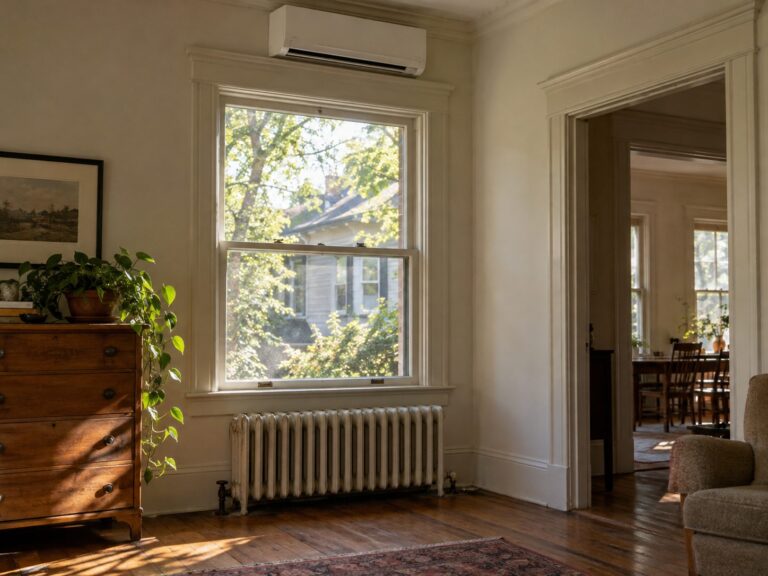
Radiators that clank through the winter. Window units humming in three rooms. A finished attic nobody can sleep in during July. If that sounds like your Annapolis house, the problem is familiar: the rooms need heating and cooling, but the house was built without a place to put the ducts.
For a house with no ducts and no clean way to add them, ductless is usually the answer. A mini-split heat pump delivers heating and cooling directly to the rooms that need it, without running new ducts through finished walls. In Annapolis’s Historic District, planning the outdoor unit is just as important as choosing the equipment.
Ductless AC for an old house
Annapolis has older homes with plaster walls, original trim, and little room for new construction. These are the houses ductless is built for:
- A rowhouse near Maryland Avenue with radiators and window air conditioners.
- A 1950s cape with a finished attic that gets too hot in July.
- A converted garage, sunroom, or addition that never received a duct connection.
- A house where extending central air would require losing closet space or lowering ceilings.
Start with the rooms you want to make comfortable and the features you want to keep. Radiators can continue providing heat while a separate ductless system adds cooling and supplemental heating. You do not have to replace a working boiler just to stop using window air conditioners.
How to cool a house with no ductwork
Installing central air in a house without ducts involves more than buying equipment. Supply and return ducts need routes through the building, which may require enclosed passages called chases, dropped ceilings, or alterations to closets and finished rooms.
That work adds carpentry, plaster repair, and repainting to the project. In a historic home, it also means disturbing original materials. Ductless avoids the need for those large duct routes by delivering heated or cooled air directly into the room.
Installation still requires mounting indoor units and making openings for refrigerant lines, wiring, and drainage. Plan those routes before work begins. You can avoid extensive duct construction while knowing where the installer will need access.
What a ductless mini-split actually does
A ductless system connects an outdoor unit to one or more indoor air-handling units, often called heads. Each indoor unit distributes air within its room or zone. A zone may be one room or an open area, depending on the layout.
Closed bedroom doors also matter. One indoor unit in a hallway may not deliver enough air to separate bedrooms. The design should account for where people sleep and spend time, rather than assuming one large unit will condition an entire upper floor evenly.
The number of indoor units depends on the model. Lennox’s MMPD multi-zone system supports up to five zones; some larger Mitsubishi SMART MULTI configurations support up to 12 indoor units. Size the system around the home’s needs rather than a maximum head count.
Mini-split heat pumps heat as well as cool. To replace radiator heat, start with a load calculation, which measures the home’s heating and cooling needs. Then match the equipment’s cold-weather capacity and room-by-room coverage to that calculation. Sizing for the coldest week is what separates a system that carries the house from one that just takes the edge off.
Scardina is a Lennox Premier Dealer and Lennox Mini-Split Specialist. We install both Lennox and Mitsubishi systems for homes in central Maryland and surrounding communities. Explore our ductless services and Mitsubishi indoor-unit options.
Air conditioning for historic homes in Annapolis
Here is the step to settle before anyone starts drilling: the outdoor unit needs historic-district approval. In the Annapolis Historic District, exterior projects require a certificate of approval under Chapter 21.56, even when they are exempt from a building permit. An outdoor condenser is mechanical equipment, and it sits in the same group the Historic Preservation Commission’s administrative guidelines cover alongside service meters, cable boxes and satellite dishes.
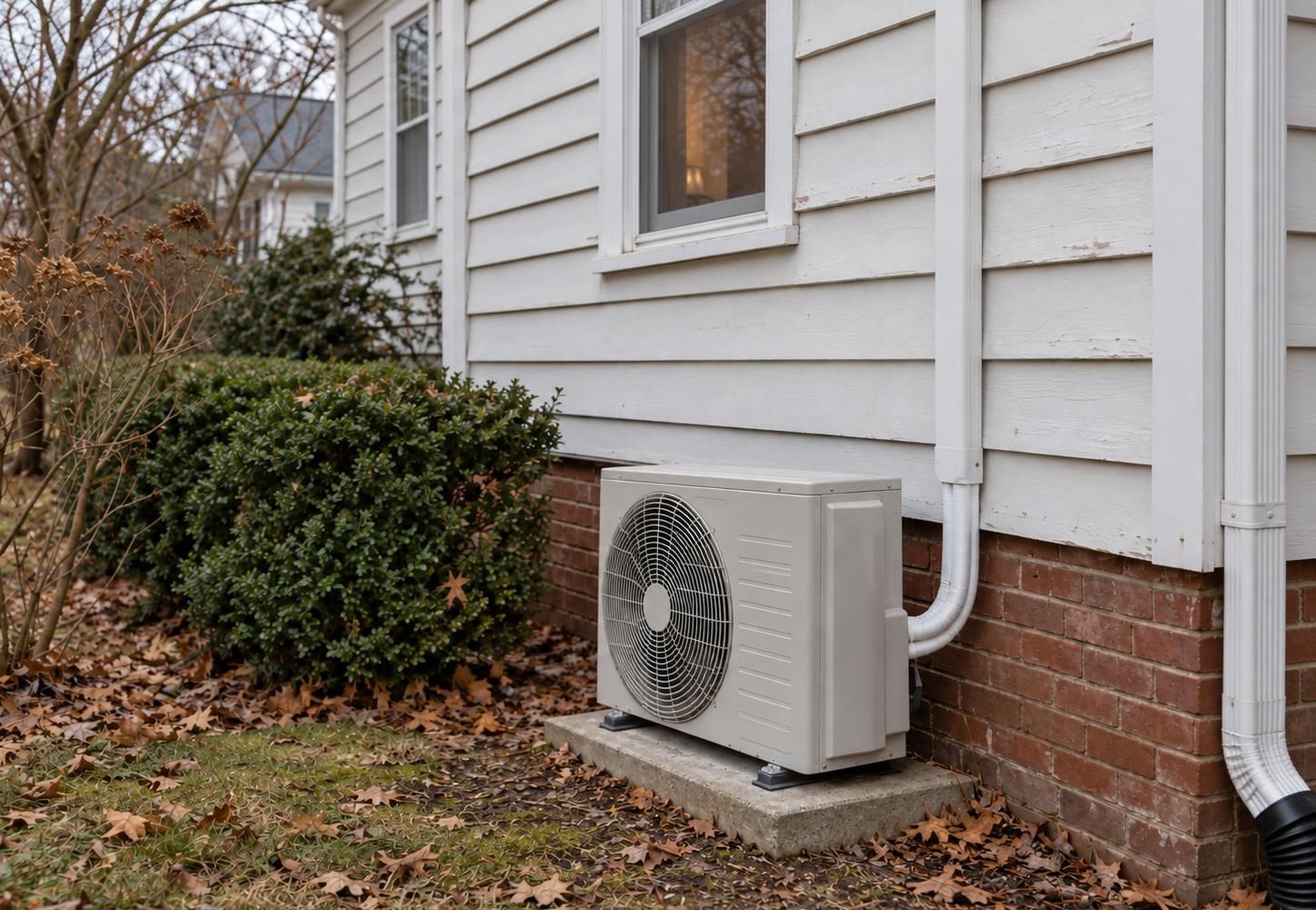
That grouping is good news, because it is the faster path. Historic Preservation Division staff are authorized to review work that meets those guidelines, and when the proposed work does, the certificate of approval is issued immediately after staff review rather than waiting for a hearing date. A complete administrative application includes a description of the work, drawings or acceptable substitutes, specifications, photographs and a site plan.
Read that list again and you can see why placement is a design decision rather than an install-day detail. Somebody has to draw where the condenser goes, and what it will look like from the street, before anything gets filed. Applications go to historic preservation staff at 145 Gorman Street, and hearing applications follow a deadline schedule published at the start of each calendar year. If the right location is genuinely in doubt, the Commission offers a pre-application meeting for a preliminary look, though its comments are not an approval.
Historic approval and mechanical or electrical permits are separate steps; check both for your address.
Mini-split cost per head and what changes the quote
For budgeting, Bryant’s 2026 manufacturer guide gives a general installed range of $2,000 to $6,000 for a single-zone system and $2,000 to $7,000 per zone for multi-zone work. These are planning ranges, not Scardina quotes or published Bryant equipment prices.
At those planning rates, a project serving several zones can reach $10,000 or more. The actual total depends on the complete equipment combination and installation. Per-zone figures help with budgeting; they do not mean every contractor bills separately for each head.
The quote should account for:
- Equipment capacity and the number of indoor units.
- A suitable electrical circuit and any necessary panel work.
- Refrigerant-line routes, particularly through masonry or finished plaster.
- Condensate drainage, mounting, permits, and any finish repairs.
Ask for the scope and exclusions in writing so competing estimates can be compared fairly.
When ductless is the wrong answer
If your house already has sound ductwork and a failing central system, start by pricing a replacement that uses those ducts. A whole-house ductless conversion is usually not the first recommendation. We would rather lose that job than sell you one you do not need.
A mini-split still makes sense for an addition, attic, or room the central system does not serve well. Compare a separate zone with extending or repairing the existing system. Fix the comfort problem in the rooms that need attention; there is no need to redesign the rest of the house.
Talk to Scardina Home Services
Talk to Scardina Home Services
If your old Annapolis house needs more comfortable heating and cooling, contact Scardina to discuss ductless options. Explore our heating and cooling services or our HVAC work in Severna Park.
Call 410.782.0937 or request a free estimate online.
Scardina Home Services, 8082 Veterans Highway, Millersville, MD 21108, 410.782.0937.
Scardina Home Services provides heating and cooling services throughout central Maryland, including Annapolis, Arnold, Crofton, Crownsville, Gambrills, Glen Burnie, Lake Shore, Millersville, Odenton, Pasadena, Severn, Severna Park and Columbia.
Sources
- Lennox MMPD Multi-Zone product documentation. Indoor-zone capacity.
- Mitsubishi Electric MXZ-SM-NLHZ SMART MULTI product documentation. Configuration-specific indoor-unit capacity.
- Bryant guide to mini-split heat pumps. System operation, installation, sizing, and sound considerations.
- Lennox dealer listing for Scardina. Premier Dealer and mini-split distinctions.
- City of Annapolis Historic Preservation Division. Exterior-change review.
- Annapolis Historic Preservation Commission Rules of Procedure. Administrative review authority (Section 2.9), filing requirements (Article 2), and pre-application meetings (Section 2.10).
- City of Annapolis Building Permit Information and Licenses and Permits Division. Permitting and historic-district requirements.
- Bryant Mini Split Cost 2026 guide. General installed budgeting ranges, not Scardina quotes.
- Anne Arundel County Mechanical Permit information. County process and permit-status contact.
Frequently Asked Questions
Can you install a mini-split in a historic home in Annapolis?
Yes, a ductless mini-split can heat and cool a historic Annapolis home without adding central ductwork. In the Annapolis Historic District, the outdoor unit and other exterior changes require a certificate of approval before installation. Plan equipment placement and line routing as part of that review.
Do I need approval from the Historic Preservation Commission for an outdoor unit?
An exterior installation in the Annapolis Historic District requires a certificate of approval. Mechanical equipment such as an outdoor condenser falls under the Historic Preservation Division’s administrative approval guidelines, so staff can review it directly, and when the proposed work meets those guidelines the certificate is issued immediately after that review. A complete administrative application includes a description of the work, drawings or acceptable substitutes, specifications, photographs and a site plan. Work that does not fit the guidelines goes to the Commission on its published hearing schedule.
How do you cool a house that has no ductwork?
Use a ductless mini-split to cool a house without adding central ductwork. An outdoor unit connects to indoor air-handling units that distribute air directly into each zone. Size and place those units for the rooms you use, accounting for the layout, insulation, and closed bedroom doors.
Do mini-splits heat as well as cool?
Mini-split heat pumps provide both heating and cooling; cooling-only models do not. To use a mini-split as the primary heat source, match its output at local winter temperatures to the home’s calculated heating needs. Keep existing radiators as supplemental heat or replace their heating role when the design supports it.
How many indoor units can one outdoor unit run?
The permitted number depends on the outdoor model and its approved indoor-unit combinations. Lennox’s MMPD supports up to five zones, while certain Mitsubishi SMART MULTI systems support up to 12 indoor units. The equipment must also have enough capacity for the spaces served. A unit count alone does not determine how many rooms will stay comfortable.
How much does a ductless mini-split cost installed?
Bryant’s 2026 guide gives general planning ranges of $2,000 to $6,000 for a single-zone installation and $2,000 to $7,000 per zone for multi-zone projects. These are not Scardina quotes. Equipment selection, electrical work, routing, drainage, and other installation conditions determine the actual project price.
Will a mini-split work in a house with radiators?
Yes, a ductless mini-split can add cooling to a house that keeps its existing radiator heat. A heat-pump model also provides another heating option. Keeping or replacing the radiator system depends on comfort goals, cold-weather capacity, and whether the existing boiler serves other needs, such as domestic hot water.baseboard heat as well.
How are the lines run through a masonry or plaster wall?
The installer plans a route for refrigerant lines, wiring, and condensate drainage between the indoor and outdoor equipment. Small wall openings are usually needed, with their size and location determined by the unit and routing. Masonry, original plaster, and concealed obstacles can affect the work. Ask how openings will be sealed and any finishes repaired.
Are mini-splits noisy indoors?
Indoor units usually operate quietly, but they are not silent. Sound depends on the model, fan setting, placement, and operating conditions. The compressor sits outdoors, which can reduce indoor noise compared with a window air conditioner. Compare the published sound ratings for the proposed indoor and outdoor units.
Is ductless cheaper than adding central air to an old house?
t can be, especially when central air would require extensive new ducts and finish repairs. Whole house ductless work can also be a substantial project, so compare complete installation estimates rather than equipment prices alone. Existing ductwork, room layout, electrical work, and the number of zones all affect the comparison.
Do I need a permit for a mini-split in Anne Arundel County?
Check the permitting authority for your address before work begins. Within Annapolis city limits, contact the city’s Licenses and Permits Division. For properties under Anne Arundel County jurisdiction, call 410-222-7730. Ask about mechanical and electrical permits. Historic-district approval is separate.