
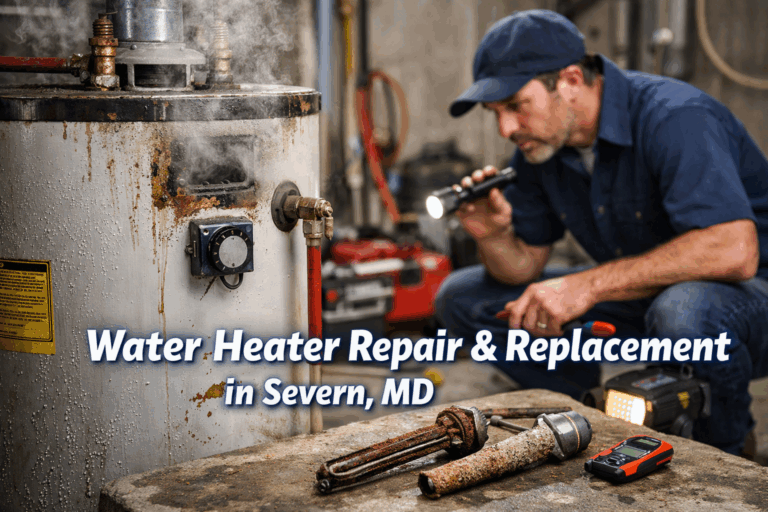
There are very few household appliances you rely on as consistently as your water heater — and very few whose failure is as immediately disruptive. A cold shower on a winter morning is an unpleasant surprise. A water heater that’s leaking from the tank is an emergency. For Severn homeowners, understanding the warning signs, knowing the difference between a repair and a replacement, and having a trusted local company ready to call can make all the difference when things go wrong.
Here’s what you need to know.
How Hard Water in Anne Arundel County Affects Your Water Heater
Water quality varies across Maryland, and the water in Severn and much of Anne Arundel County is considered moderately to significantly hard. Hard water contains elevated levels of dissolved minerals — primarily calcium and magnesium — that don’t cause health problems but do cause real damage to water heating equipment over time.
Here’s what happens: as your water heater heats water, those dissolved minerals precipitate out and settle at the bottom of the tank as sediment. Over months and years, that sediment layer builds up. It acts as an insulating barrier between the heating element and the water, forcing the unit to work harder and longer to heat the same amount of water. You’ll notice it as higher energy bills, longer waits for hot water, and eventually a rumbling or popping sound from the tank as the heating element struggles to work through the buildup.
Left unaddressed, sediment accumulation significantly shortens the lifespan of a water heater. A unit that might last 12 years in a soft water area may start failing at 7 or 8 years in Severn’s hard water conditions. Annual flushing of the tank helps slow the process, but most homeowners skip it — which means the clock runs faster than it needs to.
This is one of the reasons Severn homeowners should be paying attention to their water heater’s age and performance earlier than the national averages suggest.
Signs Your Water Heater Needs Attention
Water heaters rarely fail without warning. The signals are there — most homeowners just don’t know what to look for.
No Hot Water or Inconsistent Hot Water
The most obvious sign. If your water heater stops producing hot water entirely, the heating element or burner may have failed. If hot water runs out faster than it used to or fluctuates between hot and cold unexpectedly, the unit is likely losing efficiency due to age, sediment buildup, or a failing component. Neither situation resolves on its own.
Rumbling, Popping, or Banging Sounds
That noise coming from your water heater is sediment. As the heating element tries to work through the hardened mineral layer at the bottom of the tank, it creates a rumbling or popping sound. It’s a clear signal the tank is overdue for service — and depending on the age of the unit, may be pointing toward replacement rather than a simple flush.
Rusty or Discolored Hot Water
If the hot water coming from your taps has a brownish or reddish tint but the cold water runs clear, the corrosion is inside your water heater tank. Once the interior of a tank begins to rust, the unit is near the end of its life. There is no meaningful repair for internal tank corrosion — replacement is the answer.
Water Pooling Around the Base of the Tank
Any moisture, dripping, or pooling around the base of a water heater tank is a serious warning sign. It can indicate a slow leak from a fitting or valve — which may be repairable — or it can mean the tank itself has developed a crack or breach, which means the unit needs to be replaced immediately before it fails completely and floods the area around it.
Rising Energy Bills Without Explanation
A water heater that’s losing efficiency uses more energy to do the same job. If your BGE bill has been climbing and you haven’t changed your usage habits, your water heater is one of the first things worth evaluating. Water heating accounts for roughly 18 to 20 percent of the average home’s energy use, so an inefficient unit has a real and measurable impact on what you pay each month.
The Unit Is 10 Years Old or More
Age alone is a reason to start planning. Most conventional tank water heaters have a rated lifespan of 8 to 12 years. In Severn’s hard water conditions, units that haven’t been regularly maintained often fall on the shorter end of that range. If your water heater is approaching or past the 10-year mark — even if it’s still technically working — having it evaluated now puts you in control of the timeline rather than reacting to an emergency.
Repair vs. Replace: Making the Right Call
Not every water heater issue calls for replacement. Some problems are worth fixing. Knowing the difference saves you money in both directions — avoiding unnecessary replacements and avoiding throwing good money after bad on a unit that’s ready to fail.
Worth Repairing:
- A failed thermostat or temperature and pressure relief valve on a relatively young unit
- A burned-out heating element on an electric water heater that is otherwise in good condition and under 8 years old
- A faulty pilot light or igniter on a gas unit that is otherwise sound
- Minor fitting or connection leaks that are clearly isolated and not related to tank integrity
Time to Replace:
- Any leak originating from the tank itself rather than a fitting or valve
- Visible rust or corrosion on the tank exterior
- Rusty or discolored hot water indicating internal tank corrosion
- A unit that is 10 years or older experiencing any significant problem
- Repeated repairs within a short time frame on the same unit
- A unit still running on outdated components that are no longer readily available
A good technician will give you an honest assessment of where your unit falls — and won’t push replacement when a repair is genuinely the right call.
Tank vs. Tankless: Is It Worth Upgrading?
When replacement time comes, Severn homeowners have a decision to make: replace with another conventional tank unit, or upgrade to a tankless water heater. Both have real advantages depending on your household’s needs and budget.
Conventional Tank Water Heaters The familiar option. A tank unit stores and continuously heats a reservoir of water — typically 40 to 80 gallons — so hot water is ready when you need it. They are less expensive to purchase and install than tankless units, easier to service, and work well for most households. Modern high-efficiency tank units have improved significantly over older models and represent a solid value for many Severn homeowners.
Tankless Water Heaters Tankless units heat water on demand rather than maintaining a stored supply. They eliminate standby heat loss — the energy wasted keeping a full tank hot around the clock — and can deliver meaningful energy savings over time, particularly in households with moderate to high hot water usage. They also last significantly longer than tank units, often 20 years or more with proper maintenance. The tradeoff is a higher upfront cost for both the unit and installation, and in some cases the need for upgraded gas lines or electrical service to support the higher instantaneous demand.
For larger Severn households where hot water demand is high, or for homeowners planning to stay in the home long-term, the energy savings and extended lifespan of a tankless unit often justify the investment. For smaller households or those looking for a straightforward, budget-conscious replacement, a high-efficiency tank unit is an excellent choice.
A Scardina technician can walk you through the options based on your home’s specific setup, your household size, and your priorities — without pushing you toward the more expensive option if it isn’t the right fit.
Gas vs. Electric: What Severn Homeowners Should Know
If you’re replacing a water heater, you’ll generally replace it with the same fuel type that’s already in your home — switching from gas to electric or vice versa involves additional work and cost. However, if your home has access to natural gas and you’re currently on electric, it may be worth discussing a conversion with your technician, as gas units typically heat water faster and can cost less to operate over time depending on local utility rates.
For homes on propane rather than natural gas — more common in some of the less densely developed pockets of Anne Arundel County — the same principles apply, though propane pricing introduces a different variable into the long-term cost calculation.
What to Expect From a Water Heater Service Call
When a Scardina technician arrives at your Severn home, the process is straightforward. The technician evaluates the unit, identifies the issue or confirms the age and condition of an aging system, and gives you a clear and honest recommendation — repair or replace — along with the associated costs before any work begins.
If replacement is the right call, the old unit is removed and the new one is installed, connected, and tested the same day in most cases. You’re not left without hot water for days while waiting on parts or scheduling. If a repair is the appropriate solution, it’s handled efficiently and with a clear explanation of what was done and what to watch for going forward.
Scardina works with all major water heater brands and is equipped to handle both tank and tankless installations, gas and electric, standard and high-efficiency units. Whatever is in your home or whatever you decide to upgrade to, the team has the experience and equipment to handle it.
Don’t Wait for a Full Failure
The worst time to think about your water heater is when it’s already failed and water is spreading across your utility room floor. A unit that’s showing warning signs — age, inconsistent performance, unusual sounds, rising bills — is one that’s giving you the opportunity to act on your timeline rather than react to an emergency.
If your water heater is 8 years or older, hasn’t been serviced in several years, or is showing any of the signs described above, schedule an evaluation now. It’s a short visit that can save you from a far more stressful and costly situation down the road.
Request service or schedule a free estimate today.
Scardina Home Services 8082 Veterans Highway, Millersville, MD 21108 410.782.0937
Serving Severn, Millersville, Gambrills, Crofton, Odenton, Crownsville, Severna Park, Pasadena, Arnold, Annapolis, and all of Anne Arundel County.
Frequently Asked Questions
How long should a water heater last in Severn, MD?
Most conventional tank water heaters are rated for 8 to 12 years, but in Severn and much of Anne Arundel County, hard water conditions accelerate sediment buildup inside the tank and can shorten that lifespan — particularly in units that haven’t been regularly maintained. If your water heater is approaching 10 years old, it’s worth having it evaluated now rather than waiting for an unexpected failure. Catching it early puts you in control of the timing and the decision.
Why is my hot water rusty or discolored?
If your hot water runs brown or has a reddish tint but the cold water looks clear, the corrosion is coming from inside your water heater tank. Once the interior lining of a tank begins to rust, the unit cannot be meaningfully repaired — replacement is the appropriate solution. The longer a corroding tank is left in service, the greater the risk of a full failure and potential flooding. Call for service as soon as you notice discolored hot water.
What is that rumbling or popping sound coming from my water heater?
That noise is almost always sediment. In Severn’s hard water conditions, dissolved minerals settle at the bottom of the tank over time and harden into a layer that the heating element has to work through every time it fires. The rumbling and popping you hear is the result of that struggle. It’s a clear signal the tank is overdue for a flush at minimum — and depending on the age of the unit, may indicate that replacement is the more practical course of action.
My water heater is leaking. Is that always an emergency?
It depends on where the leak is coming from. A drip from a fitting, valve, or connection on top of or beside the tank may be a repairable issue. A leak originating from the tank itself — the body of the unit — means the tank has been breached and needs to be replaced immediately. A leaking tank will not seal itself and will eventually fail completely, potentially releasing a significant amount of water into your home. If you’re unsure where the leak is coming from, shut off the water supply to the unit and call for service right away.
Should I repair my water heater or replace it?
The answer depends on the age of the unit, the nature of the problem, and the cost of the repair relative to replacement. Minor issues on a unit under 8 years old — a failed heating element, a faulty thermostat, a bad valve — are generally worth repairing. On a unit that’s 10 years or older, most significant problems tip the math toward replacement, especially in Severn’s hard water environment where units age faster than average. A Scardina technician will give you an honest assessment of which direction makes financial sense for your specific situation.
What is the difference between a tank and a tankless water heater?
A conventional tank water heater stores and continuously heats a reservoir of water — typically 40 to 80 gallons — so hot water is ready on demand. A tankless unit heats water on demand as it flows through the unit, eliminating the energy wasted keeping a full tank hot around the clock. Tankless units cost more upfront but last significantly longer — often 20 years or more — and can deliver meaningful energy savings over time, particularly in higher-usage households. A technician can help you determine which option makes the most sense for your home, your household size, and your budget.
How does hard water affect my water heater and what can I do about it?
Hard water causes dissolved minerals to settle and harden at the bottom of the tank as sediment, reducing efficiency and shortening the unit’s lifespan. Annual flushing of the tank removes sediment buildup and helps the unit run more efficiently and last longer. A whole-home water treatment or softener system addresses the root cause by reducing the mineral content of the water before it reaches your appliances — protecting not just your water heater but your pipes, fixtures, and other appliances as well. Scardina Home Services handles both water heater service and water treatment installation throughout the Severn area.
How much does water heater replacement cost in Severn, MD?
The cost varies depending on the type of unit, the fuel source, whether any additional work is needed such as upgraded gas lines or electrical service, and the specific model selected. Conventional tank water heater replacements are generally more straightforward and less expensive than tankless installations. Scardina provides free estimates so you know exactly what you’re looking at before any work begins — no surprises on the final bill. Financing options are also available to help manage the upfront cost.
How quickly can Scardina respond to a water heater emergency in Severn?
As a locally based company operating from Veterans Highway in Millersville — just minutes from Severn — Scardina Home Services can respond significantly faster than companies dispatching from Baltimore or further away. Emergency service is available for situations that can’t wait, including a leaking tank, complete loss of hot water, or any water heater issue causing active damage to your home. Don’t wait on a true emergency.
Does Scardina service all water heater brands?
Yes. Scardina Home Services works on all major water heater brands regardless of what is currently installed in your home. For new installations, the team can help you select from a range of reliable, high-efficiency options across multiple brands and configurations — tank and tankless, gas and electric — based on your home’s setup and your household’s needs.
Request service or schedule your free estimate here. Or call directly at 410.782.0937.