
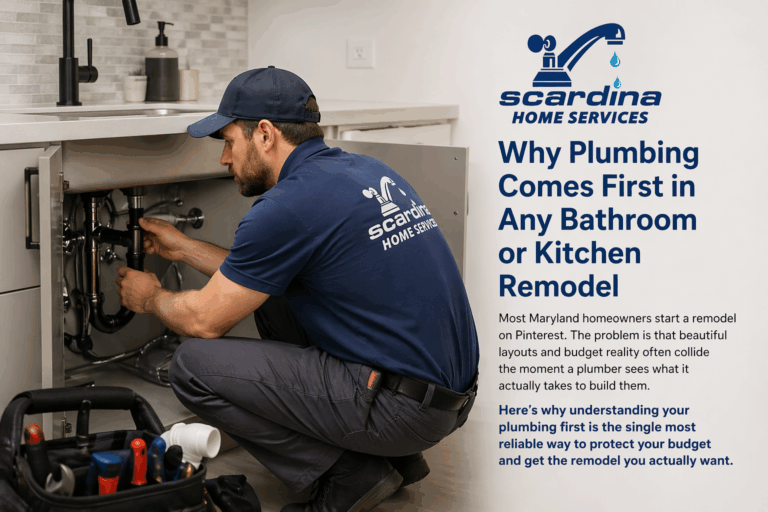
Most Remodels Start in the Wrong Place
It usually begins the same way. A homeowner opens Pinterest, saves forty or fifty photos, puts together a mood board, and falls in love with a vision. Maybe it’s a farmhouse kitchen with an island sink and a pot filler above the range. Maybe it’s a spa-style bathroom with a freestanding soaking tub centered under a window that’s currently on the wrong wall. The aesthetic is clear. The budget seems reasonable — until the first conversation with a contractor.
That’s when reality arrives, and it almost always arrives in the form of one word: plumbing.
The fixtures you move, the walls you open, the drains you relocate — these are the decisions that determine whether your remodel comes in close to budget or blows past it by thousands of dollars. And they’re decisions that get made, implicitly, the moment you commit to a layout. The problem is that most homeowners make those layout commitments based on what something will look like — not what it will cost to build.
This post is about flipping that sequence. Starting with what’s behind the walls, not what’s on the inspiration board, is the single most reliable way to protect your budget and get a finished space you’ll actually love.
The Real Cost of a Remodel Lives Behind the Walls
Before you choose a tile, a faucet, or a cabinet, the most important thing to understand is this: plumbing and electrical work typically account for 10–20% of a bathroom remodel budget Zintex — and that’s under normal conditions, when nothing unexpected is discovered.
About 1 in 3 homeowners who recently renovated a bathroom said the cost was more than expected, often because of plumbing upgrades, water damage, or structural repairs. This Old House And those are people who completed projects and were broadly satisfied with the results. The ones who went in with unrealistic expectations about what their layout would cost often ended up cutting corners on the finishes they actually wanted — the tile, the vanity, the lighting — because the money had already been spent getting the rough-in work done.
Hidden issues like water damage, outdated plumbing, and permit fees often add 10–15% beyond the original estimate. Blue Collar Scholars In older Maryland homes — and central Maryland has no shortage of them — this isn’t a worst-case scenario. It’s closer to the norm. When you open up walls and floors that haven’t been touched in decades, you find what you find.
The contingency isn’t a flaw in your plan. It’s a necessary feature of any realistic one.
The Single Most Expensive Mistake in Bathroom Remodeling
Ask any experienced plumber or remodeling contractor what drives up bathroom project costs more than anything else, and you’ll get the same answer: moving fixtures.
Every time you move a toilet, sink, or shower drain, overall project costs increase due to added labor, materials, permits, and installation time. Reico This isn’t a minor adjustment. Drains require precise slope to function. Supply lines need to be rerouted. Walls need to be opened, pipes repositioned, then patched and refinished. In many cases, permits are required. The labor compounds at every step.
Moving plumbing locations adds $1,000–$3,000 per fixture. Blue Collar Scholars A bathroom remodel that involves relocating the toilet, the shower drain, and the vanity — all common in layouts imported wholesale from an inspiration board — can easily add $5,000 or more in plumbing costs alone, before a single tile is laid or a single cabinet is installed.
This doesn’t mean you shouldn’t move fixtures. Sometimes a layout genuinely demands it, and the functional improvement is worth the cost. But it does mean that decision needs to be made consciously and early — not discovered mid-demolition when the walls are already open and your options are limited.
The designers quoted by the National Kitchen and Bath Association put it plainly: keeping plumbing in its existing location is one of the most impactful ways to control costs, because once you start moving drains or supply lines, labor and unforeseen issues add up quickly. Reico Working within the existing footprint allows more of the budget to be spent on the finishes that actually get seen and enjoyed every day.
What This Looks Like in a Kitchen Remodel
The kitchen version of this problem is just as common and often more expensive, because kitchens involve more fixtures, more appliances, and sometimes gas lines in addition to water supply and drain.
Kitchen plumbing costs typically run $4,000 to $7,000, with an average around $5,500, varying based on the number of fixtures, appliances, and piping complexity. Fixr That’s a baseline for standard work. The moment layout changes enter the picture, those numbers climb.
Moving a kitchen sink can cost anywhere from $500 for a minor shift along the same wall to $5,000 or more for a major relocation across the room or to an island. House Remodel Cost Island sinks are a perfect example of the gap between what looks beautiful on a mood board and what it takes to actually build. An island sink requires water supply lines and drain lines to run under the floor rather than through a wall, and venting an island drain is significantly more complex than venting a standard wall-mounted sink. It’s absolutely achievable — Scardina does them regularly — but the homeowner who budgets for a standard sink installation and discovers mid-project that their island requires a different approach is in for a difficult conversation.
The same principle applies to pot fillers above the range, refrigerator water lines, dishwasher hookups in new locations, and gas range installations. Every one of these requires either new line runs or relocations of existing ones. Costs for rerouting plumbing start around $500 for a basic job, but most homeowners see an average expense between $4,000 and $6,000, and more involved projects with extensive demolition or complex layouts can cost considerably more. Block Renovation
The Hidden Layer: What Old Maryland Homes Reveal
Central Maryland has a significant inventory of older homes — built in the 1960s, 70s, and 80s — where the plumbing behind the walls hasn’t been touched since original construction. When those walls come open for a remodel, what’s inside can change the scope of a project significantly.
Older homes often require plumbing updates to meet current safety standards, which can lead to unexpected expenses that add to the overall renovation budget. Issues such as outdated or poorly maintained plumbing systems frequently arise during renovations, requiring additional time and money to address. Block Renovation
Galvanized steel pipes, which were standard in homes built before roughly 1980, corrode from the inside out over time. They restrict water flow, develop leaks, and don’t meet current code for certain applications. When you open up a bathroom or kitchen wall in an older home and find galvanized supply lines, replacing them isn’t optional — it’s required before you can proceed. That’s not a contractor adding scope. That’s the house telling you what it needs.
Approximately 30% of bathroom remodels uncover water damage, which typically adds $1,000–$4,000 to the budget but is essential for preventing future problems. Blue Collar Scholars A slow drip behind a shower wall or under a kitchen sink that nobody noticed — or that got painted over — shows up the moment the wall comes down. Addressing it at that point is not optional. Enclosing it behind new tile would be both a code violation and an invitation for mold.
The point isn’t to scare anyone away from remodeling. It’s to prepare you for the reality that in an older home, a thorough pre-project plumbing assessment isn’t a luxury — it’s the thing that allows you to build a realistic budget in the first place.
Why a Plumber Should Be in the Room Before the Designer
Most remodeling projects begin with a design consultation. You discuss what you want the space to look like, you develop a layout, and then — sometime later, sometimes much later — a plumber or contractor looks at what the design actually requires and tells you what it will cost to build.
By that point, you’re emotionally invested. You’ve seen the renderings. You know exactly where the freestanding tub goes and where the double vanity sits. Walking any of that back feels like losing something. And so many homeowners don’t walk it back — they absorb the cost instead, eating into the budget that was supposed to go toward the tile and fixtures they actually wanted.
The smarter sequence runs the other way. Before the design is locked, a licensed plumber walks the space and answers the questions that actually determine your budget:
- Where are the current drain lines, and what would it cost to move them?
- Is the existing supply plumbing in serviceable condition, or does it need updating before anything is enclosed?
- What’s the condition of the subfloor around the tub or shower — is there any moisture damage that needs to be addressed first?
- If the desired layout requires moving the toilet or relocating a drain, what does that actually cost in this specific home?
- Are there permit requirements for the planned work, and what inspections will be needed?
These answers don’t kill a remodel. They shape it into something buildable. A designer working with accurate plumbing constraints from the start produces a layout that can actually be constructed for the quoted price. A designer working without them produces something that looks great until demolition day.
At Scardina Home Services, we’re frequently brought in at exactly this stage — before the design is final — to provide a plumbing assessment that becomes part of the project’s foundation rather than a mid-project surprise.
What “Full-Service” Actually Means
One of the realities of remodeling in central Maryland is that most homeowners piece together their projects from multiple separate contractors. A general contractor manages the overall build. A separate tile company does the tile work. A big-box store delivers the fixtures. And a plumber gets called in — sometimes at the last minute — to hook everything up.
This approach works, sometimes. But it also creates gaps. When the tile is already set and the vanity is already delivered and the layout is already committed, the plumber’s job is to make whatever’s been designed actually function — whether or not the design was built around plumbing realities or despite them.
Scardina Home Services works differently. Our team handles the plumbing side of bathroom and kitchen remodels as a full partner in the process — involved early, communicating throughout, and coordinating with whatever other contractors are on the project. We also handle the broader scope of home systems: if your remodel reveals that your water heater is aging, your water lines need updating, or your drain system needs attention, we can address all of it in one coordinated project rather than leaving you to schedule three separate service calls.
That coordination is where homeowners save real money. A plumber who knows the full scope of a project can make intelligent decisions about sequencing, materials, and what’s worth addressing proactively versus what can wait. A plumber who shows up at the end to connect fixtures doesn’t have that context.
A Practical Guide to Budget Planning for Bathroom and Kitchen Remodels
Here’s a realistic framework for thinking about remodel costs before you get your first contractor quote:
Bathroom remodel — what to plan for: The average bathroom remodel costs between $6,456 and $24,715 for spaces measuring 40–150 square feet This Old House, and that range is wide for a reason. Staying within the existing footprint and keeping fixtures in their current locations is the single most effective way to keep costs toward the lower end. Moving a single fixture adds $1,000–$3,000. Moving multiple fixtures, or discovering water damage or aging supply lines during demolition, pushes costs meaningfully higher.
Because surprises are common, it’s smart to set aside an extra 10–20% of your budget for contingencies. Modernize In an older Maryland home, lean toward 20%.
Kitchen remodel — what to plan for: Kitchen plumbing alone typically runs $4,000–$7,000 Fixr even without major layout changes. If your design involves moving the sink, adding an island sink, or relocating appliances with water or gas connections, budget for the additional complexity explicitly rather than hoping it’ll be absorbed somewhere else.
Before any design is finalized, ask your plumber: “What would this layout cost, and what would it cost if we kept everything where it is?” The answer to that question is one of the most valuable pieces of information you can have going into a remodel.
What to Do Before You Start
If you’re in the early stages of thinking about a bathroom or kitchen remodel, here’s a straightforward sequence that protects your budget and keeps the project grounded in reality:
Step 1: Get a plumbing assessment before you finalize any design. Understand what your existing infrastructure looks like, what condition it’s in, and what it would cost to support the layouts you’re considering. This typically takes a couple of hours and costs far less than discovering the same information mid-demolition.
Step 2: Build your design within the constraints you actually have. A skilled designer working with accurate plumbing constraints will produce a better result than one designing in a vacuum. The best remodels are ones where every decision was made with full information.
Step 3: Budget honestly, including contingency. For older homes in central Maryland, 15–20% contingency is not pessimistic. It’s realistic. If you don’t need it, that’s a win. If you do, you’re prepared.
Step 4: Work with a contractor who handles the plumbing side as a full partner, not an afterthought. The gap between a remodel that comes in close to budget and one that balloons is almost always in how well the plumbing was planned and coordinated from the start.
You Don’t Have to Choose Between Beautiful and Buildable
The remodeling projects that deliver the most satisfaction — the ones Maryland homeowners brag about to their neighbors — aren’t the ones where the homeowners ignored budget reality and got lucky. They’re the ones where a skilled team helped translate a vision into something that could be built cleanly, for a price that made sense, in a home that was ready for it.
That’s exactly what Scardina Home Services does. We’re not the plumber who shows up at the end of a remodel to connect the fixtures. We’re the team that helps you understand what your home’s plumbing will support, what it will cost to build what you want, and how to make decisions that you’ll be proud of years from now.
Ready to Start Your Remodel the Right Way?
Scardina Home Services provides full plumbing services for bathroom and kitchen remodels throughout central Maryland — including Glen Burnie, Severn, Millersville, Odenton, Crofton, Crownsville, Pasadena, Severna Park, Annapolis, and surrounding communities. We work alongside your design and build team or can connect you with trusted partners throughout the process.
📞 Call us at 410.782.0937 🌐 Request a free consultation at scardinahome.com/estimate-service
Let’s talk about what your home can support — before you fall in love with something it can’t.
Frequently Asked Questions
Do I need a plumber involved before I even have a design?
Yes — ideally. A plumber’s assessment of your existing infrastructure shapes every meaningful budget decision in a remodel. If you wait until the design is finalized to find out what the plumbing will cost, you’re likely to discover that the layout you love is significantly more expensive than you expected. Bringing a plumber in early — before the design is locked — lets you make informed tradeoffs and build a realistic budget from the start rather than revising it under pressure mid-project.
How much does it add to a bathroom remodel to move the toilet?
Moving a toilet typically adds $1,000–$3,000 to a project, depending on how far it moves and what’s involved in rerouting the drain line. Toilets require a specific drain diameter and slope, and the drain connection ties into your home’s main stack — which means any relocation involves opening floors or walls to access and extend that connection. In older homes, this work sometimes reveals pipe conditions that need to be addressed before the new toilet can be properly connected.
What’s the difference between a renovation and a remodel when it comes to plumbing?
A renovation typically updates or refreshes a space without changing the underlying layout — replacing a vanity in the same location, retiling a shower without moving the drain, updating fixtures on existing supply lines. A remodel involves changing the layout or structure of the space — moving fixtures, reconfiguring the footprint, or altering what’s behind the walls. Renovations involve minimal plumbing changes. Remodels almost always involve significant ones. The distinction matters because the plumbing complexity — and cost — is very different between the two, even when the finished spaces look similar.
Can Scardina handle both the plumbing and the broader remodel?
Scardina Home Services manages the full plumbing scope of bathroom and kitchen remodels, including rough-in work, fixture installation, drain and supply line work, and any updates to your home’s broader water or drain systems uncovered during the project. We also offer handyman services and remodeling support and can coordinate with other trades. The most effective projects are ones where the plumbing side is fully integrated into the project from the start — and that’s exactly how we work.
Our home was built in the 1970s. Should we expect surprises?
Yes — and you should budget for them. Homes from that era typically have galvanized steel supply lines, which corrode from the inside out and may need to be replaced before new fixtures can be properly installed. You may also find cast iron drain lines that are aging or partially blocked, and in wet areas like bathrooms, there’s a meaningful chance of finding some degree of water damage in the subfloor or behind wall surfaces. None of this is a reason to avoid remodeling — it’s a reason to have a licensed plumber assess the space first and build your contingency budget accordingly. Scardina can walk through your home before any design work begins and give you a clear picture of what your existing infrastructure looks like.
How do permits work for a bathroom or kitchen remodel in Maryland?
In Maryland, any work that involves moving or significantly altering plumbing typically requires a permit from your local jurisdiction — in Anne Arundel County, that means filing with the County’s Inspections and Permits division. Permits require inspections at key stages of the work to verify code compliance, and unpermitted work can create significant problems when you sell the home. Scardina handles the permitting process as part of our remodeling work — you don’t need to navigate that on your own.