
The Best Part of a Maryland Fall Is Still Outside
Maryland doesn’t have the longest outdoor season, but it has one of the best. From late April through early November — nearly seven months — central Maryland evenings are exactly the kind of weather that makes outdoor living worthwhile: warm enough to be comfortable, cool enough to want a fire, and far enough from summer humidity that sitting outside past 8 p.m. feels like a reward rather than a survival exercise.
The problem most homeowners run into is that they spend those months either standing around a wood fire they had to build and tend, or they just go inside. Neither of those is the best use of a Maryland backyard.
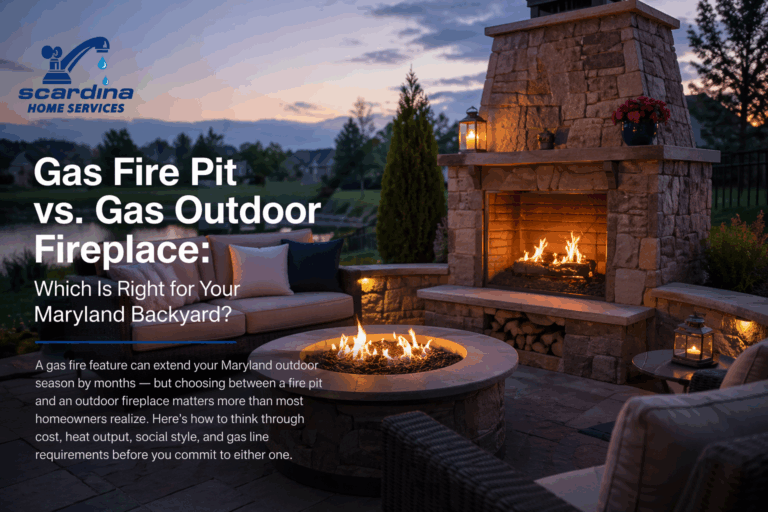
Gas fire features change that equation entirely. Whether it’s a permanent fire pit built into your patio or a stately outdoor fireplace anchoring a dedicated entertaining space, a gas-connected outdoor fire feature means instant ambiance on demand — no hauling wood, no smoke in your face, no waiting for anything to get going. You sit down, press a button, and you have fire.
The question most Maryland homeowners get stuck on isn’t whether to add a gas fire feature. It’s which one. And the answer depends on more than aesthetics — it depends on how you use your outdoor space, how much you want to spend, and what your yard can actually support from a gas line perspective.
This guide breaks it all down.
First: Why Gas Over Wood?
Before getting into the fire pit vs. fireplace comparison, it’s worth addressing the fuel question directly, because some Maryland homeowners still assume wood is the default.
Gas — whether natural gas or propane — offers several meaningful advantages for a permanent outdoor installation:
Convenience. There is no build time, no kindling, no babysitting the fire for the first 20 minutes. A gas feature is lit with the push of a button and extinguished the same way. For weeknight use — which is when most people actually use their outdoor space — this matters enormously.
No smoke. Gas burns clean. You can sit anywhere around the fire without tracking the wind or ending up in the smoke path. This is a bigger quality-of-life improvement than most people realize until they’ve experienced it.
Safety and control. Gas flames are fully controllable and fully extinguishable at a moment’s notice. There are no embers, no sparks, and no smoldering coals to manage for hours after you’re done.
Regulatory advantage. In many Maryland jurisdictions, wood-burning recreational fires come with restrictions around size, fuel type, and smoke production. Gas features, connected to a permanent line, are generally exempt from open-burning regulations. Maryland open burning laws define a recreational fire as one burning dry, aged natural wood in an open receptacle, limited to three feet in diameter Kustomscapesandpools — a definition that gas features don’t fall under at all. For homeowners in denser neighborhoods or communities with HOA oversight, this distinction can matter.
Return on investment. Gas fire pits have the highest return on investment compared to wood-burning options when homeowners sell their property. Angi More broadly, fire features offer up to 78% ROI and are considered one of the most popular backyard improvements for relaxing and entertaining. BOSSCAT
Gas Fire Pit: What It Is and Who It’s Best For
A gas fire pit is an open, typically circular or square fire feature at ground or table level, usually integrated into a patio or hardscape. The fire burns from a burner set within fire glass, lava rock, or decorative media, and is supplied by a natural gas line running underground from your home’s existing gas service, or by a propane tank connection.
The defining characteristic of a fire pit is that it’s open on all sides — people can gather around it in a full circle, the way you would around a campfire. It’s an inclusive, social focal point rather than a directional one.
What a Gas Fire Pit Does Well
Social atmosphere. Because everyone sits around the fire on all sides, a gas fire pit creates the campfire experience without any of the campfire inconvenience. It’s the feature that keeps a group of people outside talking for two hours after dinner without anyone planning for it.
Integration with existing hardscape. A fire pit — particularly an in-ground or built-in version — integrates cleanly into a patio or outdoor living area. It can be designed as a central feature of a seating area, with the surrounding space organized around it.
Lower entry cost. The average cost of a natural gas fire pit is around $1,700, with prices ranging from $400 to $3,000 for the unit itself. Angi A built-in gas fire pit with surrounding hardscape and professional gas line installation will run higher — gas fire pits with installed gas lines typically run between $6,000 and $10,000 depending on the difficulty of running the gas line and the surrounding materials Outback Landscape Inc — but this is still substantially less than an outdoor fireplace.
Flexibility in scale. Fire pits range from modest conversational pieces to large-scale custom builds. A smaller fire pit suits an intimate seating area for four to six people; a larger custom installation can anchor an expansive outdoor entertaining space.
Limitations to Understand
Heat output is limited. Gas fire pits produce a pleasant, visible flame, but they do not radiate heat the way a wood fire does, and they send much of their warmth directly upward rather than outward toward the people sitting around them. On a mild October evening, a gas fire pit is perfect. On a cold November night when you want to genuinely stay warm, it’ll be ambiance rather than heat.
Open design means exposure. Because a fire pit is open on all sides, wind affects the flame more than it does with a fireplace. Strong gusts can push the flame around or, in extreme cases, blow it out. Wind guards — tempered glass panels that surround the fire — address this effectively, but they’re an additional cost.
No vertical privacy or architectural presence. A fire pit is a ground-level element. It creates atmosphere but not structure. If you want a feature that reads as a true architectural statement in your backyard, a fire pit on its own may not achieve that.
Gas Outdoor Fireplace: What It Is and Who It’s Best For
An outdoor fireplace is a vertical, enclosed structure — built from stone, brick, stucco, or prefabricated materials — that contains and directs a gas flame through an opening and exhausts combustion products through a chimney or flue above. It looks like a traditional indoor fireplace but is engineered for exterior use.
Where a fire pit is social and open, an outdoor fireplace is formal and directional. It creates a focal wall — a defined destination in the outdoor space — and the seating arrangement faces it rather than surrounding it.
What an Outdoor Gas Fireplace Does Well
Architectural impact. An outdoor fireplace is a structural statement. It defines the space around it, gives the backyard a sense of permanence and design intention, and reads unmistakably as a feature when you see it. Outdoor fireplaces typically add $5,000–$15,000 in property value Modfire — a reflection of the premium feel they create.
Heat. A fireplace radiates heat outward toward the seating area in a way that a fire pit doesn’t. The structure itself absorbs heat and re-radiates it. For Maryland homeowners who want to genuinely extend their outdoor season into November and December, a fireplace is the more practical choice.
Wind resistance. The enclosed structure and chimney draft mean that wind does not affect a fireplace flame the way it does a fire pit. You can have a fire on a blustery fall evening without managing the flame.
Covered and screened porch compatibility. An outdoor fireplace — properly vented — can be installed under a covered structure, including a pergola or screened porch, in ways that an open fire pit typically cannot. This makes it the right choice for homeowners designing a true year-round outdoor room rather than an open patio feature.
Privacy and separation. A freestanding outdoor fireplace creates a visual barrier and a sense of enclosure in the space, which can be useful in yards with open rear property lines or close neighbors.
Limitations to Understand
Higher cost. This is the most significant practical difference. Most homeowners spend between $1,500 and $8,000 on an outdoor fireplace, with fully custom projects ranging to $21,000 or more. Home Advisor Custom stone or masonry fireplaces designed as the centerpiece of a full outdoor living project can cost significantly more. This is not a modest addition — it’s a substantial investment.
Directional seating. Everyone faces the fire, which creates a more formal arrangement and limits how many people can comfortably use the space at once. For a large, casual gathering where people want to circulate, a fireplace is less naturally social than a fire pit.
Requires significant footprint. An outdoor fireplace is a substantial structure that needs space — both in terms of the footprint of the structure itself and the setback from property lines, structures, and other combustibles. Smaller urban and suburban lots in central Maryland may not have the space to site a fireplace comfortably.
Side-by-Side: Gas Fire Pit vs. Gas Outdoor Fireplace
| Gas Fire Pit | Gas Outdoor Fireplace | |
|---|---|---|
| Social Style | 360° gathering | Directional / formal |
| Heat Output | Ambient / limited | Strong radiant heat |
| Typical Installed Cost | $3,000–$10,000 | $8,000–$21,000+ |
| Property Value Added | $2,000–$8,000 Modfire | $5,000–$15,000 Modfire |
| Wind Sensitivity | Moderate (add wind guard) | Low |
| Works Under Cover | Not typically | Yes, with proper venting |
| Extends Season Into Cold Weather | Mild evenings | Into late fall / early winter |
| Architectural Impact | Ground-level focal point | Full structural statement |
| Space Required | Moderate | Substantial |
| Best For | Casual entertaining, social gatherings | Formal outdoor rooms, year-round use |
The Gas Line Question: What Maryland Homeowners Need to Know
Whichever feature you choose, the most important thing to understand upfront is that a permanent gas fire feature — whether fire pit or fireplace — requires a permanent, professionally installed gas line. This is not optional and not a DIY project.
According to a master plumber and co-owner of a Rockville, Maryland plumbing company, the most common calls for gas line installation are from homeowners who already have gas for their furnace and water heater and want to extend gas functionality to a fireplace or outdoor fire pit. Bob Vila
Here’s what that gas line work actually involves for a Maryland homeowner:
Running the line. A licensed gas plumber tees off your existing gas supply, runs a line — typically underground — from the house to the location of the fire feature. The cost to run a gas line to an outdoor fire pit runs approximately $20–$25 per linear foot for flexible tubing run under a deck or yard. Angi The distance from your gas meter to your desired fire feature location is the primary cost driver here. A fire feature 30 feet from the house costs meaningfully less to connect than one 80 feet away at the far end of a patio.
Sizing the line. The gas line needs to be properly sized for the BTU demand of the feature. A larger fireplace or fire pit with a high-output burner requires more gas delivery capacity than a smaller unit. Undersizing the line produces an underperforming flame.
Permitting and inspection. In Anne Arundel County and throughout central Maryland, gas line work requires a permit and inspection. Scardina Home Services handles this process — you don’t have to navigate it yourself — but it’s important to understand that this isn’t an unregulated installation. Proper permitting protects your home and ensures the work meets code.
Shut-off valves. For safety, a licensed installer will install shut-off valves both near the main line and directly at the fire feature, allowing you to cut gas quickly if needed.
Natural gas vs. propane. If your home already has natural gas service, extending it to an outdoor feature is typically the most cost-effective and convenient long-term solution. Natural gas provides a steady fuel supply and lower ongoing costs, making it a great choice for permanent setups, while propane delivers higher BTU output and suits areas without existing gas line access. Pro Landscape For Maryland homes that have natural gas for heating and appliances — which is the majority of homes in the communities Scardina serves — connecting a fire feature to the existing gas service is almost always the right call.
Which One Is Right for Your Maryland Backyard?
Rather than a definitive answer, here’s a framework for thinking through the decision based on your specific situation:
Choose a gas fire pit if:
- You want an accessible, social feature that creates atmosphere for casual gatherings
- Your budget is in the $5,000–$10,000 range including installation and gas line work
- You have an existing patio or hardscape you want to enhance rather than rebuild
- Your outdoor entertaining style is informal — people circulating, kids present, relaxed evenings rather than structured seating
- You’re adding the feature to an open backyard space without existing overhead coverage
- Mild fall evenings are your target use case more than cold-weather outdoor living
Choose an outdoor gas fireplace if:
- You want a permanent architectural statement that defines your outdoor space
- You’re building or renovating a full outdoor living area and want a centerpiece
- Extending your outdoor season into cold weather is a priority
- You’re creating a covered outdoor room — a pergola, screened porch, or fully covered patio — that needs an appropriate heat source
- Your budget accommodates the higher investment, or you’re treating it as part of a broader outdoor living project
- Your yard has the footprint to site the structure properly with appropriate setbacks
Consider doing both if: A number of Maryland homeowners who are doing full outdoor living builds choose to include both a gas fireplace as the architectural anchor and a smaller fire pit as a casual gathering feature in a separate seating area. This sounds ambitious, but running the gas line for both features is often only marginally more expensive than running it for one — the bulk of the gas line cost is in the distance from the house, not in adding a second connection point once the line is already out there.
The Gas Line Is Where Scardina Comes In
Scardina Home Services installs and services gas lines for outdoor fire features throughout central Maryland. Whether you’re working with a landscape contractor or hardscape company on the overall backyard project, or managing the design yourself, we handle the gas side — from the existing line at your home to the connection at your fire feature — properly permitted, properly inspected, and correctly sized for the feature you’ve chosen.
We also service and inspect existing gas lines for homeowners who already have a fire feature and want to make sure the installation is sound, or who want to add a feature to an area that already has gas stubbed out nearby.
If you’re in the planning phase, we can walk through your yard, assess your existing gas infrastructure, and give you a clear picture of what gas line work will cost for the location and feature you have in mind — before you’ve committed to anything.
Ready to Extend Your Maryland Outdoor Season?
Scardina Home Services serves central Maryland homeowners throughout Glen Burnie, Severn, Millersville, Odenton, Crofton, Crownsville, Pasadena, Severna Park, Annapolis, and surrounding communities. Our licensed gas team handles residential gas line installation for outdoor fire features, gas fireplaces, gas fire pits, fire torches, and outdoor gas appliances.
📞 Call us at 410.782.0937 🌐 Request a free consultation at scardinahome.com/estimate-service
The first fire of fall is better with gas. Let’s get you set up before the season arrives.
Frequently Asked Questions
Do I need a permit to install a gas fire pit or outdoor fireplace in Maryland?
Yes. Any work involving a new gas line connection or extension requires a permit in Maryland, including in Anne Arundel County. The gas line installation itself must be done by a licensed plumber, and the work must be inspected before it’s approved. Scardina Home Services manages the permitting and inspection process as part of every gas line installation — you don’t have to navigate the county process on your own.
How far from my house does a gas fire feature need to be?
Clearance requirements vary by jurisdiction and feature type, but as a general standard, outdoor fire pits should be at least 10 feet away from a home. Angi Outdoor fireplaces, which are larger structures, typically require greater clearance. Your specific lot, local code, and HOA rules (if applicable) all factor in. When Scardina assesses your yard for gas line installation, we can help confirm that your planned location meets applicable setback requirements before any work begins.
What’s the difference between natural gas and propane for an outdoor fire feature?
Both work well for outdoor fire features. Natural gas provides a steady, continuous fuel supply and lower ongoing fuel costs, making it ideal for permanent installations. Propane offers portability and slightly higher BTU output, which suits areas without access to natural gas lines. Pro Landscape For most central Maryland homeowners who already have natural gas service in their home, extending that line to an outdoor fire feature is the most convenient and cost-effective long-term option. For homes on propane or without gas service, a buried propane tank can supply a permanent outdoor feature effectively.
Can I connect a gas fire feature to my home’s existing gas line?
In most cases, yes — provided the existing line has sufficient capacity and there is an accessible tap point. Most homes in central Maryland that have gas heat, a gas water heater, or gas appliances have a sufficient existing service to add an outdoor fire feature. The practical considerations are the distance from your existing gas line to the desired fire feature location and whether the current line can handle the additional BTU load. Scardina assesses both when providing an estimate.
How long does it take to install a gas line for an outdoor fire feature?
A straightforward gas line installation — running underground from the house to a patio fire feature — typically takes one to two days, including the trench work. More complex installations, such as those covering longer distances, navigating obstacles like mature root systems or existing hardscape, or connecting multiple features, will take longer. Permit review timelines are the main scheduling variable — Scardina submits permits promptly and schedules inspection as early as possible to minimize any delays.
Can a gas fire pit or fireplace be used under a pergola or covered patio?
A gas fire pit is generally not recommended for use under a low covered structure — the open flame and upward heat need appropriate clearance. An outdoor gas fireplace with a properly functioning chimney or flue can often be installed under a covered structure, provided the clearances and venting are engineered correctly. If you’re designing a covered outdoor room and want to include a gas fire feature, discuss the specifics with Scardina before the structure is built — the right venting configuration is much easier to plan in advance than to retrofit.