

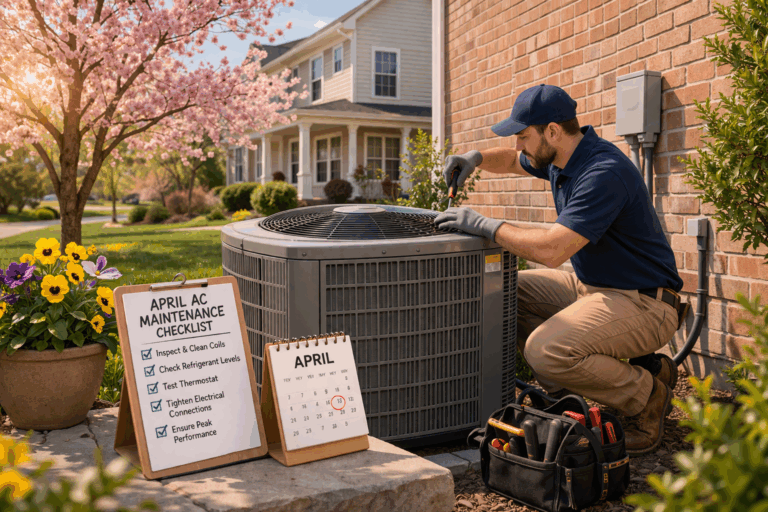
Every summer, the same thing happens across central Maryland. Temperatures climb into the 90s in June, the humidity rolls in off the Chesapeake, and homeowners who haven’t touched their AC since last September start turning it on for the first time. Some systems fire up without a hitch. Others don’t — and those homeowners are suddenly calling every HVAC company in Anne Arundel County, only to find out the soonest available appointment is two weeks out.
That scenario is entirely avoidable. And April is exactly the window you need to act.
Here’s why this month — right now — is the single best time to have your AC serviced in central Maryland, and what happens to homeowners who wait.
Maryland Summers Are Genuinely Brutal on HVAC Systems
Before getting into timing, it’s worth understanding what your air conditioner is actually up against every year in this region.
Maryland’s humid summers with temperatures regularly climbing into the 90s put extra strain on AC systems in a way that milder climates simply don’t. Bpmhvac This isn’t a generic observation — it’s a climate reality specific to the mid-Atlantic. Maryland sits in IECC Climate Zone 4A, classified as mixed-humid. During peak summer temperatures near 88°F, AC units work significantly harder, and the state’s 64% average humidity adds a substantial dehumidification load that consumes far more energy than dry climates require. Best Pick Reports
By July, temperatures often rise into the 90s and the humidity makes it feel even hotter. It’s no coincidence that most systems fail right in the middle of a heatwave — your air conditioner runs longer cycles and works harder to maintain comfort, which is exactly when deferred maintenance problems become full failures. Frhvac
The systems most likely to fail in July are the ones that went into summer already compromised — with dirty coils, low refrigerant, clogged drains, or worn components that nobody caught because nobody looked.
The Rush Is Real — and It’s Coming Fast
HVAC call volumes in Maryland increase two to three times during summer heat waves. Best Pick Reports That’s not a slight uptick in demand — it’s a surge that books service schedules solid and stretches wait times for non-emergency appointments from days into weeks.
Service call fees can run 20–40% higher during summer for air conditioning-related visits. Diagnostic and service call fees that might normally be $75–$200 can rise to $300 or more during peak season, and emergency service rates may double or triple. Samsara
HVAC companies get flooded with repair calls once the summer heat kicks in. By booking early, you avoid the long wait times and rushed service that often come with peak season. Spring appointments are typically more flexible, allowing you to choose a time that works with your schedule. 24hrhcs
The math here is straightforward: the same service that costs less and gets scheduled on your timeline in April becomes expensive and hard to get in July. You’re not just buying peace of mind when you service your AC in spring — you’re locking in better pricing, better availability, and a technician who isn’t rushing between three emergency calls.
April Is the Ideal Window — and Here’s Why
Not all of spring is created equal for AC service. April hits a specific sweet spot that makes it the best month of the year for this type of work.
When outside temperatures range between 60–75°F, HVAC technicians can test your cooling system properly without overworking it. This moderate weather allows for accurate performance testing. The mild climate also means your home stays comfortable during maintenance, as you won’t need to worry about extreme heat while your system is temporarily offline. Mountainwestac
The ideal time for spring maintenance falls between mid-March and early April, before temperatures consistently reach the 70s. During this period, HVAC companies aren’t yet busy with emergency calls, making it easier to schedule your preferred appointment time. Bpmhvac
There’s also a practical advantage that’s easy to overlook: if repairs need fixing, you won’t have to struggle through the heat while the work is done. Spring is the best time to do this because you don’t yet need your AC. Hiller If a technician discovers a failing capacitor, a refrigerant leak, or a part that needs ordering, you have weeks of buffer time to get it resolved — rather than sweating through an unplanned two-day repair window in August.
What a Spring AC Tune-Up Actually Covers
A professional spring tune-up is significantly more than a filter swap. Here’s what a thorough service visit from a licensed HVAC technician should include:
Coil cleaning — Both the evaporator coil (inside) and condenser coil (outside) are inspected and cleaned. Dirty coils are one of the leading causes of reduced efficiency and system failure. Dirty condenser coils alone can raise energy consumption by up to 30%, forcing your system to work much harder. Idahofallsheatingandcooling
Refrigerant check — Low refrigerant is a common and often undetected problem that causes your system to run constantly without ever reaching your set temperature. It also accelerates compressor wear.
Capacitor and contactor inspection — Capacitors and contactors are two of the most common parts to fail during peak summer demand. Idahofallsheatingandcooling Testing them in April costs a fraction of what an emergency replacement costs in July.
Condensate drain clearing — Summer humidity accelerates algae growth in clogged drain pans, causing water backups that trigger safety shutoffs. Idahofallsheatingandcooling A spring cleaning prevents a mid-summer shutdown caused by something as simple as a clogged drain line.
Blower motor and airflow testing — Restricted airflow from dirty components causes motors to overheat and fail prematurely. A technician will measure airflow and make sure air is moving through your system and ductwork correctly.
Thermostat calibration — An improperly calibrated thermostat causes your system to run longer than necessary, driving up energy bills without improving comfort.
Electrical connection inspection — Loose or corroded connections are a safety risk and a common cause of component failure under the stress of sustained summer operation.
The Energy Savings Start Immediately
Beyond reliability, a properly serviced AC system simply costs less to run all summer long.
Pre-summer AC maintenance reduces cooling costs by 5–15% according to U.S. Department of Energy estimates. Idahofallsheatingandcooling For a Maryland home running its AC heavily from June through September, that’s meaningful money back in your pocket every month.
AC units lose roughly 5% efficiency per year without regular service. After five years of skipped tune-ups, a system may be consuming 25% more electricity to deliver the same amount of cooling. Idahofallsheatingandcooling If you’ve been putting off maintenance for a few years, the efficiency gap between where your system is and where it could be is substantial.
Older Homes in Central Maryland Face Extra Risk
Central Maryland has a large concentration of homes built during the 1970s and 1980s suburban expansion — many of which have HVAC systems that are aging alongside them. In central Maryland’s established residential corridors, HVAC contractors frequently perform humidity-focused air quality assessments because standard air conditioners in older homes often struggle to pull enough moisture out of the air during oppressive summer conditions. Best Pick Reports
Most air conditioners should last 10–15 years, but without proper care, many fail prematurely. Consistently maintained AC units typically last 3–5 years longer than neglected systems. Mountainwestac If your system is 8 years or older and hasn’t been serviced in more than a year, April isn’t just a good time to schedule a tune-up — it may be an important opportunity to catch a system that’s quietly approaching the end of its life before it fails on the hottest day of the year.
Signs You Definitely Shouldn’t Wait
Even if your system ran fine last summer, schedule service now if any of the following apply:
- It’s been more than a year since your last professional tune-up
- Your energy bills last summer were noticeably higher than the year before
- Your system ran constantly but struggled to keep up on the hottest days
- You heard unusual noises — rattling, banging, or grinding — when the AC was running
- Rooms cooled unevenly with some areas significantly warmer than others
- Your system is 10+ years old — at this age, annual inspection becomes essential
- You noticed water near the indoor unit last season, which indicates a drain issue
An air conditioner can look perfectly fine during mild weather and still have problems quietly building in the background. A seasonal check can uncover wear, drainage problems, dirty coils, or other performance issues before they affect daily comfort. Innovative Air
Don’t Wait Until You Need It to Find Out It Doesn’t Work
The worst HVAC outcomes are almost always the result of deferred action. There’s nothing worse than having your AC die on a 90-degree day, only to find out every HVAC company in town is booked solid. Emergency appointments are harder to get, more expensive, and usually come with longer wait times, especially during Maryland’s peak summer season. Frhvac
April gives you something no other month does: time. Time to schedule on your terms, time to repair rather than emergency-replace, and time to go into summer knowing your system is ready for whatever Maryland throws at it.
📞 Ready to Get Ahead of the Rush?
Scardina Home Services installs, services, and repairs nearly all heating and cooling equipment — all makes and all models throughout central Maryland. Our licensed technicians are available now, before the summer surge hits, to make sure your AC is clean, efficient, and ready for the season ahead.
Our spring AC services include:
- Full system tune-ups and inspections
- Coil cleaning and refrigerant checks
- Capacitor, contactor, and electrical testing
- Condensate drain clearing
- Thermostat calibration and airflow testing
- AC repair and replacement for all makes and models
April appointments fill up fast. Don’t wait until your neighbors have already called.
📱 Call Us: 410.782.0937 | 💻 Request Service Online
Serving Millersville, Annapolis, Baltimore, and communities throughout central Maryland.
Frequently Asked Questions
How often should I have my AC professionally serviced?
Once a year is the standard recommendation, and spring is the ideal time. If your system is older than 10 years or has had issues in previous seasons, twice-yearly service — spring for the AC, fall for the heating — gives you the best protection against unexpected failures.
What’s the difference between a tune-up and a repair?
A tune-up is preventive — a technician inspects, cleans, tests, and optimizes a system that’s currently functional. A repair addresses a specific problem that’s already causing an issue. Tune-ups are designed to find small problems before they become repairs, which is why they’re significantly less expensive than reactive service.
My AC ran fine last summer. Do I still need a tune-up?
Yes. A system that performed well last summer went through months of heavy use — and central Maryland summers are among the most demanding in the country for HVAC systems. Components wear during operation, coils accumulate debris, drain lines develop buildup, and refrigerant levels can drift. “Running fine” last season doesn’t mean the system is in the same shape it was when it started.
How long does a spring AC tune-up take?
A thorough professional tune-up typically takes 60–90 minutes. If the technician discovers additional issues — a refrigerant leak, a failing capacitor, ductwork concerns — that appointment may run longer or require a follow-up visit. Either way, catching those issues in April beats catching them in July.
Will servicing my AC now actually lower my energy bills this summer?
Yes, measurably. The U.S. Department of Energy estimates that pre-summer AC maintenance reduces cooling costs by 5–15%. A system with dirty coils, a clogged filter, or low refrigerant consumes significantly more electricity to deliver the same cooling — and that shows up on your bill every month from June through September.
My system is about 12 years old. Should I repair or replace?
Age alone isn’t a reason to replace a system, but it’s a reason to have an honest conversation with a technician. A 12-year-old system that’s been well maintained and is running efficiently may have several good years left. One that has deferred maintenance, higher-than-normal energy consumption, or is requiring frequent repairs is often approaching the point where replacement is the smarter investment. Scardina’s team can assess your specific system and give you a straightforward answer — call us at 410.782.0937 or schedule online.
Is there any benefit to scheduling now versus waiting until May?
Yes — availability and cost. April is still early in the pre-season window. May starts filling up fast as temperatures rise and more homeowners think about their AC. Scheduling in April gives you the widest choice of appointment times and the best chance of getting in before the seasonal pricing and demand increases kick in.