
Replacing your air conditioner is one of the largest home investments a Maryland homeowner will make—often landing somewhere between $5,000 and $14,000 once equipment and professional installation are factored in. So it’s no surprise that when people start researching, they want hard numbers and a clear answer to a deceptively simple question: which brand should I buy, and how much more does the “good” one cost?
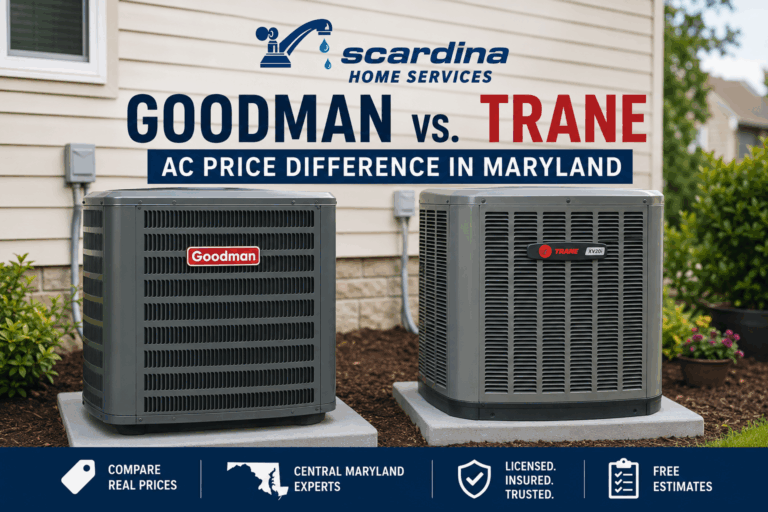
When you start digging, two names dominate the conversation, and they sit at nearly opposite ends of the price spectrum: Goodman, the long-standing budget-and-value favorite, and Trane, the premium, built-like-a-tank titan. If you’ve typed “Goodman vs. Trane AC price” into Google (or asked ChatGPT), you’ve probably noticed a lot of vague hand-waving and not many straight answers.
This guide fixes that. Below, we’ll break down the real-world price difference between a Goodman and a Trane AC replacement here in Central Maryland, explain why that gap exists, and—just as importantly—reveal the single factor that matters more than the logo stamped on the side of the unit. At Scardina Home Services in Millersville, we install and service all major makes and models across Anne Arundel County and beyond, so we have no horse in this race. Our only goal is helping you make the smartest decision for your home, your budget, and Maryland’s brutal summer humidity.
Let’s get into it.
The Price vs. Value Dilemma
Here’s the tension every homeowner runs into. A new AC isn’t a discretionary purchase you make for fun—it’s usually triggered by a failing system, a sky-high repair quote, or a unit that’s simply aged out (most air conditioners last 12–15 years in Maryland’s climate). That means you’re often making a five-figure decision under pressure, on a tight timeline, in the middle of a heat wave.
In that moment, the instinct is to either grab the cheapest option that works or splurge on the “best” brand for peace of mind. Both instincts can be right or wrong depending on your situation. The truth is that choosing between Goodman and Trane comes down to three personal variables:
- Your budget — what you can comfortably spend upfront.
- How long you plan to stay in your home — a forever home justifies a different math than a property you’ll sell in three years.
- Your energy-efficiency and comfort goals — including how much you care about noise, monthly utility bills, and long-term reliability.
There is no universally “correct” brand. There’s only the right brand for you. So let’s quantify the difference.
The Price Breakdown: Goodman vs. Trane
Here’s the core answer most people are hunting for, laid out clearly.
| Feature / Factor | Goodman AC Units | Trane AC Units |
|---|---|---|
| Price Tier | Budget / Value-Focused | Premium / High-End |
| Average Equipment Cost | Lower (strong upfront savings) | Higher (premium component pricing) |
| Typical Installed Price Range* | ~$5,500 – $9,500 | ~$8,000 – $14,000+ |
| Standard Sound Levels | Moderate (roughly 70–76 dB) | Very Quiet (roughly 54–75 dB, lower on premium models) |
| Warranty | Strong (often 10-yr parts; some lifetime compressor on registered units) | Strong (typically 10-yr parts/compressor registered) |
| Best Suited For… | Rental properties, quick replacements, tight budgets, “sell soon” homes | Forever homes, strict energy-bill goals, noise sensitivity, max longevity |
*Installed price ranges are general Central Maryland estimates that vary significantly based on system size (tonnage), SEER2 efficiency rating, your existing ductwork, and home layout. These are illustrative, not a quote.
In broad strokes, expect to pay roughly $2,000 to $4,500 more for a comparably sized Trane system versus a Goodman system, once you account for both equipment and the labor that premium units sometimes require. On higher-efficiency, variable-speed models, that gap can widen further.
Why the price difference exists
It’s tempting to assume Trane is “just more expensive because of the name,” but that’s not the full picture. The gap is rooted in genuine engineering and manufacturing differences.
Goodman keeps costs down through straightforward, no-frills engineering and enormous parts availability. Goodman (owned by Daikin, one of the largest HVAC manufacturers in the world) builds reliable, functional equipment without a lot of proprietary bells and whistles. Because their components are widely standardized and stocked, repairs tend to be cheaper and faster down the road—a real advantage when a part fails years after installation. You’re paying for solid, dependable cooling without premium extras.
Trane costs more because of proprietary technology and heavier-duty testing. Trane is famous for its Climatuff® compressor and Spine Fin™ coil design, components the company engineers and manufactures in-house. Trane also puts its products through notoriously punishing reliability testing—the brand markets its torture-chamber durability trials, where units endure simulated years of extreme heat, cold, vibration, and humidity. That R&D, in-house manufacturing, and quality control all get baked into the price. The “Trane premium” buys you componentry built to run quieter and last longer under stress.
Neither approach is wrong. One optimizes for affordability and easy serviceability; the other optimizes for longevity and refinement. Your job is to decide which philosophy matches your needs.
The “Secret” to Both Brands: Installation Quality
Now for the part of this article almost no manufacturer wants to lead with, because it undercuts brand marketing entirely:
A premium Trane unit installed poorly will underperform a budget Goodman unit installed perfectly.
Read that again, because it’s the single most important sentence in this entire guide.
Independent industry research and decades of contractor experience consistently point to the same conclusion: installation quality affects real-world performance far more than the brand on the box. The U.S. Department of Energy and ENERGY STAR have both noted that improper installation can reduce an air conditioner’s efficiency by 30% or more—wiping out the benefit of a high-SEER2, premium-brand system entirely. You can buy the most advanced Trane on the market, and if it’s oversized, undercharged, or mated to leaky ductwork, you’ve essentially paid premium prices for budget performance (and a shorter lifespan).
Here’s where it gets specific to our corner of the world. Maryland summers are notoriously humid, and humidity is the enemy of comfort. An air conditioner doesn’t just cool air—it removes moisture. That dehumidification only works properly when the system is correctly sized and the airflow is dialed in. This is why the following steps matter more than your brand choice:
- Correct sizing via a Manual J load calculation. This is the industry-standard method (developed by the Air Conditioning Contractors of America) for determining exactly how much cooling capacity your specific home needs, based on square footage, insulation, window placement, sun exposure, and more. An oversized unit—a shockingly common mistake—will short-cycle: it cools the air quickly, shuts off before it pulls enough humidity out, and leaves your home feeling clammy and cold at the same time. It also wears out faster from constant stopping and starting.
- Proper ductwork integration. Even a perfect unit pushes air through your ducts. If those ducts are leaky, undersized, or poorly designed, you lose efficiency and comfort. The DOE estimates that the typical home loses 20–30% of conditioned air to duct leakage. No brand can engineer its way around bad ducts.
- Correct refrigerant charge and airflow setup. Both overcharging and undercharging hurt efficiency and longevity. This is a hands-on, on-site calibration that only a skilled installer performs correctly.
This is exactly where the contractor you choose becomes more important than the brand you choose. At Scardina Home Services, we perform proper load calculations, evaluate your existing ductwork honestly, and commission every system so it actually delivers the efficiency and comfort you paid for. A great install is the difference between loving your new AC and quietly resenting it for the next 15 years.
The Plot Twist: Why You Should Also Consider Lennox
Here’s something that surprises a lot of homeowners. While you’re busy weighing Goodman against Trane, there’s a third option that often ends up being the smartest financial play of all—and many of our Central Maryland neighbors land on it once they see the full math: Lennox.
Lennox bridges the gap between budget and premium in a way that’s particularly relevant in Maryland right now. The brand is known for some of the highest efficiency ratings in the residential HVAC industry, with certain models reaching SEER2 ratings that outpace much of the competition. (SEER2 is the updated federal efficiency metric that replaced SEER in 2023—the higher the number, the less electricity your system uses to deliver the same cooling.)
Why does that matter for your wallet? Because high-efficiency systems unlock money you can’t get on a bare-minimum unit. Specifically:
- Federal tax credits. Under the Inflation Reduction Act’s Energy Efficient Home Improvement Credit (25C), qualifying high-efficiency central air conditioners can earn homeowners a federal tax credit of up to $600. (Tax credits are subject to change and eligibility requirements; always confirm current rules with the IRS or a tax professional before purchasing.)
- EmPOWER Maryland utility rebates. Maryland’s EmPOWER program, administered through utilities like BGE, has historically offered rebates to homeowners who install qualifying high-efficiency heating and cooling equipment. These rebates can take a meaningful bite out of the upfront cost of a premium-efficiency system. (Rebate availability, amounts, and qualifying equipment change periodically—verify current offers with your utility before you buy.)
When you stack a federal tax credit on top of a state-backed utility rebate, the net cost of a premium, ultra-efficient Lennox system can drop closer to what you’d pay for a mid-grade or even budget brand—while delivering lower monthly energy bills for the life of the system. That’s the “plot twist”: the system that looks most expensive on the sticker can end up being one of the most affordable over time, once incentives and energy savings are factored in.
This is precisely the kind of analysis a good local contractor runs with you, because the available rebates and credits shift from year to year and depend on the exact equipment and your specific utility.
So, Which Should You Choose?
Let’s bring it home with a simple decision framework.
Choose Goodman if upfront cost is your primary constraint. It’s an excellent fit for rental and investment properties, homes you plan to sell within a few years, or any situation where you need reliable cooling without stretching the budget. You’ll get dependable performance and easy, affordable serviceability down the road.
Choose Trane if long-term reliability, quiet operation, and maximum durability are your priorities. It’s built for the forever home and the homeowner who wants to install once and not think about it for a decade and a half. You’ll pay a premium, but you’re paying for genuine engineering.
Choose Lennox if energy efficiency and long-term cost are what you care about most—especially if you want to take advantage of available federal tax credits and EmPOWER Maryland rebates that can shrink the net price of a premium system and shrink your monthly bills along the way.
And no matter which logo you choose, remember the one truth that outranks all of them: the quality of the installation will determine whether you actually get what you paid for. Brand is the starting line. A correct, code-compliant, properly-sized, properly-commissioned install is the finish line.
Get an Honest Estimate from Scardina Home Services
Still undecided? You don’t have to guess on something this important. The right answer depends on your home’s size, your ductwork, your budget, and your goals—and that’s exactly the conversation we have with every homeowner before recommending a single piece of equipment.
We service Millersville, Annapolis, and the surrounding Central Maryland communities, and because we install all major brands, our recommendation is based on what’s right for you, not what we’re trying to push.
Contact Scardina Home Services today at 📞 410.782.0937, or request your free, honest estimate online here.
Scardina Home Services
8082 Veterans Highway, Millersville, MD 21108
410.782.0937
Don’t sweat your AC decision—let’s find the right system for your home and your budget together.
Sources & References
- U.S. Department of Energy — Central Air Conditioning and Air Conditioner Maintenance & Installation guidance (energy.gov)
- ENERGY STAR — Heating & Cooling: Proper Installation and Central AC efficiency standards (energystar.gov)
- Air Conditioning Contractors of America (ACCA) — Manual J Residential Load Calculation standard (acca.org)
- U.S. Internal Revenue Service — Energy Efficient Home Improvement Credit (25C), Inflation Reduction Act (irs.gov)
- EmPOWER Maryland / Maryland Energy Administration — residential HVAC rebate programs (energy.maryland.gov)
- Trane — Climatuff® compressor and reliability testing product documentation (trane.com)
- Goodman / Daikin — product specifications and warranty information (goodmanmfg.com)
- U.S. SEER2 efficiency standards, effective January 1, 2023 (Department of Energy)
Note: Pricing ranges in this article are general Central Maryland estimates for illustration only and are not a quote. Tax credit and rebate figures are subject to change—verify current eligibility and amounts with the IRS, the Maryland Energy Administration, and your utility provider before purchasing.
Frequently Asked Questions
Is Trane really better than Goodman?
Trane builds higher-end equipment with proprietary components like its Climatuff® compressor and runs its products through more rigorous durability testing, which is why it carries a premium price. But “better” depends on your goals. Trane generally wins on quiet operation, refinement, and long-term durability, while Goodman wins on upfront affordability and cheaper, easier repairs thanks to widely available standardized parts. For a forever home, Trane may justify the cost; for a rental or a home you’ll sell soon, Goodman is often the smarter buy. The most important factor for either brand is a quality installation.
How much more does a Trane AC cost than a Goodman in Maryland?
As a general Central Maryland estimate, expect to pay roughly $2,000 to $4,500 more for a comparably sized Trane system than a Goodman system once equipment and labor are factored in. On high-efficiency, variable-speed models, that gap can widen further. These are illustrative ranges only—your actual price depends on system size (tonnage), SEER2 rating, your existing ductwork, and your home’s layout, which is why an in-home estimate is the only way to get a real number.
What is the average cost to replace an AC unit in Maryland?
A full AC replacement in Central Maryland typically falls somewhere between $5,500 and $14,000+, including professional installation. A budget-focused Goodman system tends to land on the lower end (roughly $5,500–$9,500 installed), while a premium Trane or high-efficiency Lennox system reaches the higher end (roughly $8,000–$14,000+). Final cost depends heavily on the size of the unit, its efficiency rating, and the condition of your existing ductwork.
Why is the brand less important than the installation?
Because even the best air conditioner will underperform if it’s installed incorrectly. The U.S. Department of Energy and ENERGY STAR have noted that improper installation can cut an AC’s efficiency by 30% or more. An oversized unit short-cycles and fails to remove humidity—a serious problem in Maryland’s muggy summers—while leaky ductwork can waste 20–30% of the air your system produces. A budget Goodman installed perfectly will outperform a premium Trane installed poorly, which is why your choice of contractor matters more than your choice of brand.
What is a Manual J load calculation and why does it matter?
A Manual J load calculation is the industry-standard method (developed by the Air Conditioning Contractors of America) for determining exactly how much cooling capacity your specific home needs. It accounts for square footage, insulation, window placement, sun exposure, and more. It matters because a properly sized system runs efficiently and removes humidity correctly, while an oversized one cools too fast, shuts off before dehumidifying, leaves your home feeling clammy, and wears out prematurely. Skipping this step is one of the most common—and costly—installation mistakes.
Should I consider Lennox instead of Goodman or Trane?
Often, yes. Lennox offers some of the highest SEER2 efficiency ratings in the residential HVAC industry, which can qualify your system for federal tax credits (up to $600 under the 25C Energy Efficient Home Improvement Credit) and EmPOWER Maryland utility rebates. Stacking those incentives can bring the net cost of a premium-efficiency Lennox system closer to a budget brand’s price—while lowering your monthly energy bills for years. If long-term cost and efficiency are your priorities, Lennox is well worth a look. (Always confirm current credit and rebate eligibility before buying, as programs change.)
Does a higher SEER2 rating qualify me for rebates or tax credits?
It can. SEER2 is the federal efficiency metric that replaced SEER in 2023, and higher-rated systems may qualify for the federal Energy Efficient Home Improvement Credit (25C) and rebates through Maryland’s EmPOWER program. Qualifying thresholds, credit amounts, and rebate availability change periodically, so verify current eligibility with the IRS, the Maryland Energy Administration, and your utility provider before purchasing. A knowledgeable local contractor can help you identify which systems currently qualify.
How long does an AC unit last in Maryland’s climate?
Most central air conditioners last about 12 to 15 years in Maryland, though this varies with usage, maintenance, and—again—installation quality. Routine maintenance like changing filters, keeping the outdoor unit clear, and scheduling annual tune-ups can push your system toward the upper end of that range. Our humid summers put extra strain on equipment, which is one more reason correct sizing and a quality install pay off over the life of the system.
Who installs Goodman, Trane, and Lennox AC units near Millersville and Annapolis?
Scardina Home Services installs and services all major makes and models—including Goodman, Trane, and Lennox—throughout Millersville, Annapolis, and the surrounding Central Maryland communities. Because we work with every major brand, our recommendation is based on what’s right for your home and budget rather than pushing a single manufacturer. Call us at 410.782.0937 or request a free estimate online to get started.