
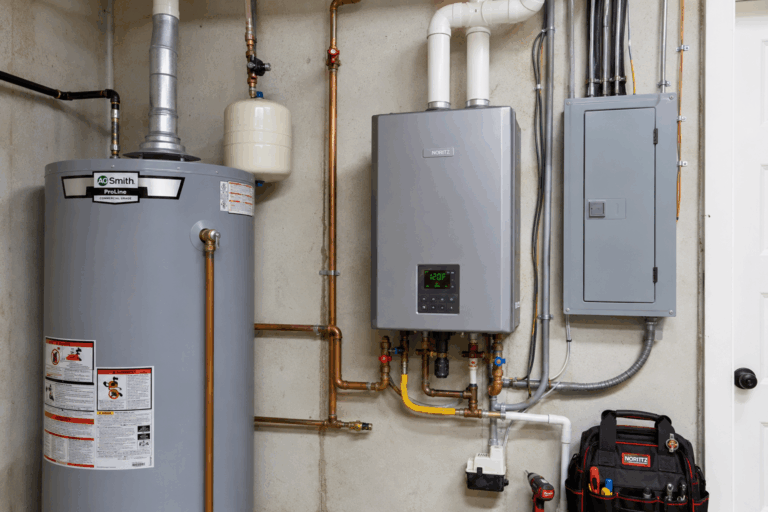
The internet is full of tank versus tankless comparisons. They cover the usual ground — tankless units are more efficient, last longer, and take up less space; tank units are cheaper upfront and simpler to install. Most of those posts end with some version of “it depends on your situation” and leave you to figure out the rest.
This isn’t that post.
What most comparisons skip is the part that actually determines whether a tankless water heater makes sense for your specific home: the installation. Not the concept of installation, but the actual physical and infrastructure requirements — the gas line work, the venting, the electrical panel, the permits — and why a tankless swap is a categorically different project than a tank-to-tank replacement.
Understanding these specifics before you call anyone means you can evaluate quotes accurately, ask the right questions, and avoid the scenario where a homeowner agrees to a “simple” tankless installation and then discovers mid-project that the gas line needs to be replaced, the vent needs to be rerouted, and the panel needs an upgrade.
What a Standard Tank Replacement Actually Involves
Start here, because the contrast matters.
Replacing an aging tank water heater with a new tank water heater of the same type — gas-to-gas or electric-to-electric — is one of the more straightforward plumbing projects a licensed plumber performs. The existing gas line or electrical circuit is already sized for a tank unit. The venting pathway is already in place. The plumber drains and removes the old tank, connects the new one to the existing supply and return lines, reconnects the gas or electrical connection, restores the vent, and verifies operation. In most cases, the same infrastructure that served your 12-year-old tank will serve its replacement.
That relative simplicity is what many homeowners — and some contractors — assume carries over to a tankless installation. It often doesn’t.
The Gas Line: The Most Commonly Underestimated Upgrade
If you’re installing a gas tankless unit to replace a gas tank, this is the item most likely to surface an unexpected cost.
A standard gas tank water heater operates at roughly 30,000 to 40,000 BTUs per hour. That’s the gas demand the existing line in most homes is sized to supply.
It is common for a tankless water heater to require four to five times the typical BTU input of a storage tank water heater. Do not assume that the fuel gas and venting system that already exists will be adequate for a tankless water heater changeover. Moreno Valley
Gas tankless units require a much higher input — typically 90,000 to 130,000 BTU per hour — than storage tanks, which often necessitates a gas line upgrade during installation. Gogreen-hvac
In practical terms: your old tank heater likely used 30,000 to 40,000 BTUs, while a new tankless unit might need 90,000 to 130,000 BTUs. This often means your existing half-inch gas line must be upgraded to a one-inch line as part of the installation. Flow Pro Plumbing
The line size matters because gas flow is governed by pipe diameter. A half-inch line that adequately served your tank simply cannot deliver the volume of gas a tankless unit needs to fire at full demand. Running undersized gas to a tankless unit causes the system to modulate down — you get less hot water output than the unit is rated for, especially during simultaneous draws.
Beyond the line coming to the water heater, the installer also needs to evaluate the gas meter itself. The existing gas meter must be able to supply enough gas for the tankless unit plus all other gas appliances. If the meter is too small, the utility company will need to upgrade it before installation. This is a step that happens outside the plumber’s scope — it requires coordination with BGE or your gas utility, which adds time to the project. Tnstandard
The bottom line on gas: a plumber assessing a tankless installation must trace the gas supply from the meter, evaluate the existing line size and run length, determine whether it can meet the new demand, and quote accordingly. A contractor who doesn’t do this assessment before quoting is either not being thorough or is planning to figure it out once they’re on-site.
Venting: Why Tankless Units Can’t Use What’s Already There
A gas tank water heater vents through a conventional flue — in most older Maryland homes, this means a B-vent (a double-walled metal pipe) that routes combustion gases up through the house and out through the roof, often sharing a flue with the furnace.
A gas tankless water heater almost always cannot use this existing venting. Here’s why.
Tankless units are high-efficiency condensing or non-condensing appliances with different combustion characteristics than tank units. Non-condensing tankless units produce hot exhaust that must be vented through stainless steel Category III or IV vent pipe — not the standard B-vent material used for tank units. All tankless units require corrosion-resistant, gas-tight Category III stainless steel venting. This specialized venting prevents leaks and ensures durability. Ciriello
Condensing tankless units — which are more efficient because they extract additional heat from exhaust gases — produce cooler, moist exhaust that can actually be vented through PVC or polypropylene pipe. This sounds like an advantage, and it is for venting cost. But condensing units also produce condensate — acidic water — that must be routed to a drain. That’s an additional plumbing consideration.
Direct-vent configurations draw combustion air from outside through a dedicated intake pipe and exhaust through a separate pipe — typically a concentric (pipe-within-pipe) system that exits through the wall rather than the roof. This is a common and practical configuration for Maryland basements where a sidewall penetration is easier than routing through the roof. But it requires drilling through the foundation wall, maintaining specific clearances from windows, doors, and neighboring vents, and sealing exterior penetrations properly.
Vent pipe specifications must be properly sized for the unit’s BTU output and use approved materials resistant to condensation and corrosion. Clearance requirements dictate that vent terminations must maintain specific distances from windows, doors, air intakes, and property lines to prevent combustion gas infiltration. Tnstandard
In practical terms: the existing vent pathway from your old tank water heater is very likely not usable for a tankless unit. A new vent run — in the correct material, properly sized, with correct termination clearances — is typically part of any tankless installation. The cost and complexity of that run depends on where the new unit is located and what the path to the exterior looks like.
Electric Tankless Units: The Panel Problem
Electric tankless water heaters eliminate the gas line and venting considerations entirely — but they create a different, and often more significant, infrastructure challenge: electrical capacity.
A standard electric tank water heater draws about 4,500 to 5,500 watts and runs on a 30-amp, 240-volt circuit. Most Maryland homes with electric water heaters already have this circuit in place.
Electric heaters require significant electrical power, typically two to three 40-amp, 240-volt circuits. Your electrical panel capacity may need an upgrade, adding to the cost. Flow Pro Plumbing
The numbers are stark. Electric tankless units pull between 40 and 170 amps depending on their size and how much hot water they produce. A larger unit on a 240-volt line might draw 130 to 150 amps. Compare that to the 18 to 20 amps a standard electric tank draws, and the scale of the infrastructure difference becomes clear. Heater For Water
Many older 100-amp or 150-amp services will lack adequate capacity, and a service panel upgrade — commonly to 200 amps or larger — is often required when adding a whole-house tankless heater. ExpertCE
For a central Maryland home with a 100-amp panel — common in homes built before the 1980s — a whole-house electric tankless installation typically cannot proceed without a panel upgrade. That upgrade involves a licensed electrician, a permit, an inspection, and often coordination with the utility to upgrade the service entrance. It’s a significant project layered on top of the water heater installation itself.
This is why many homeowners who call for a “simple electric tankless swap” get a quote that surprises them. The water heater itself may be a reasonable cost. The electrical infrastructure to support it may equal or exceed that cost.
Point-of-use electric tankless units — small units installed at a single fixture rather than serving the whole house — have much more modest electrical requirements and can often be added without panel modifications. But they only supply hot water to the fixture they serve, which makes them supplemental rather than whole-house solutions.
What a Proper Pre-Installation Assessment Covers
A reputable plumber quoting a tankless installation doesn’t just price the unit and the labor to hang it on the wall. A thorough assessment covers:
Gas systems: Tracing the gas supply from the meter, measuring existing line diameter, calculating whether the current line can meet the new BTU demand, identifying the routing for any new gas line work required, and evaluating the meter capacity.
Venting: Identifying where the new unit will be located, determining the most practical and code-compliant path to the exterior, specifying the correct vent material for the unit type, and noting any clearance considerations at the termination point.
Electrical: For gas units, confirming the location of the nearest 120-volt outlet for the unit’s control board. For electric units, evaluating the existing panel capacity, the availability of open breaker slots, the current service amperage, and whether a panel upgrade or utility service upgrade is required before proceeding.
Water supply: Confirming adequate water pressure (tankless units typically require a minimum of 30 to 40 PSI to activate) and assessing the existing pipe connections for sizing and condition.
Permits: In Maryland, a permit is required for gas line work, new electrical circuits, and mechanical installations including water heater replacements. The assessment should include what permits will be pulled and what inspections will follow.
A quote that doesn’t address all of these items is either incomplete or is planning to surface those costs as additions once the project has started. Neither outcome is in your interest.
The Honest Assessment: When Tankless Makes Sense and When It Doesn’t
Tankless water heaters have genuine advantages — energy efficiency, longevity (20+ years versus 10 to 12 for a tank), and space savings. For the right home with the right infrastructure, they’re an excellent long-term investment.
The homes where tankless installs are most straightforward are those that already have adequate gas line capacity (or were built with it), have a practical exterior wall for venting, and in the case of electric units, have modern panels with sufficient capacity. In these situations, the installation is more involved than a tank swap but not dramatically so.
The homes where tankless installs surface the most unexpected costs are older central Maryland homes — pre-1980s construction with half-inch gas lines, older panels, and chimney venting that served the original appliances well but needs significant upgrading to support modern on-demand equipment. These aren’t reasons not to go tankless. They’re reasons to understand the full scope before committing.
A tank-to-tank replacement in the same fuel type remains the lowest-complexity, lowest-cost water heater project. If your priorities are reliability, predictable cost, and minimum installation disruption, a quality tank unit from a reputable brand — sized correctly for your household — accomplishes everything a tankless unit does for hot water delivery at a lower total installation cost.
If your priorities are long-term energy savings, freeing up basement space, or never running out of hot water during high-demand periods, tankless is the right direction — just with a realistic picture of what the installation actually requires.
Get a Straight Assessment from Scardina Home Services
Scardina Home Services installs both tank and tankless water heaters for homeowners throughout central Maryland — including Glen Burnie, Severn, Crofton, Gambrills, Odenton, Pasadena, Annapolis, Severna Park, Arnold, and the surrounding communities in Anne Arundel County. We assess your gas line, venting, and electrical situation before quoting, so the number we give you reflects what the project actually requires — not a base price with additions to follow.
Call us at 410.782.0937 or request a free estimate online.
Scardina Home Services | 8082 Veterans Highway, Millersville, MD 21108 | 410.782.0937 | scardinahome.com/services/water-heaters
Frequently Asked Questions
How much more does a tankless installation actually cost compared to replacing a tank?
The honest answer is that it varies enough that a general number would be misleading. A gas tankless installation where the existing gas line is already adequately sized, the venting path to an exterior wall is straightforward, and no electrical upgrades are needed will cost more than a tank swap but not dramatically so. A gas tankless installation that requires running a new gas line from the meter, rerouting venting, and pulling permits will cost significantly more. An electric tankless installation that triggers a panel upgrade can add several thousand dollars to the project before the water heater itself is even factored in. This is why a proper pre-installation assessment matters so much — not to uncover problems, but to give you an accurate total cost before you commit. We assess gas, venting, and electrical before quoting so the number you get reflects the full project.
Can I keep my existing gas line when switching to a tankless unit?
Sometimes, but it requires evaluation rather than assumption. The determining factors are the diameter of your existing line, the run length from the meter to the water heater location, and whether any other appliances share that line. A half-inch gas line that adequately served a 40,000-BTU tank water heater almost never has sufficient capacity to supply a tankless unit requiring 90,000 to 130,000 BTUs. A three-quarter-inch line may or may not be adequate depending on run length and what else it’s feeding. There’s no way to know without tracing and measuring the existing supply — which is exactly what a thorough pre-installation assessment does. Don’t accept a tankless quote from any contractor who hasn’t evaluated your gas supply before pricing the job.
My house has a 100-amp electrical panel. Can I get an electric tankless water heater?
In most cases, not without a panel upgrade first — and that upgrade is a significant additional cost. A whole-house electric tankless unit typically draws 100 amps or more, and a 100-amp service panel simply doesn’t have the capacity to support that load on top of everything else in the home. Even a 150-amp panel may be insufficient depending on your home’s existing electrical load. Before pursuing an electric tankless unit, have a licensed electrician assess your current panel capacity against the unit’s requirements. If a panel upgrade is necessary, that cost needs to be factored into the total project cost — not discovered after you’ve already purchased the unit. For homes with panel constraints, a gas tankless unit or a heat pump water heater are often more practical alternatives.
Can a tankless unit use the same vent as my old tank water heater?
Almost never, and trying to make it work creates real safety risks. Standard tank water heaters use B-vent — double-walled metal pipe — which is typically insufficient for the high-temperature, positive-pressure exhaust of a non-condensing tankless unit. Using the wrong vent material can result in exhaust leaking into the home, which is a carbon monoxide hazard. Condensing tankless units produce cooler exhaust that can use PVC or polypropylene, but they also produce acidic condensate that needs to be properly drained. Most tankless installations in Maryland basements use a direct-vent configuration — a concentric pipe that draws combustion air in from outside and exhausts through the same wall penetration. This typically means a new sidewall penetration rather than routing through the existing roof flue. The vent material, sizing, and termination clearances all have to meet manufacturer specifications and local code — it’s not interchangeable with what’s already there.
How long does a tankless water heater actually last compared to a tank?
Tankless water heaters typically last 20 or more years with proper maintenance — roughly twice the lifespan of a standard tank unit, which averages 10 to 12 years. That longevity is part of the financial case for tankless: the higher upfront installation cost gets amortized over a longer service life. The caveat is that “with proper maintenance” is doing real work in that sentence. Tankless units — particularly in central Maryland with its moderately hard water — benefit from periodic descaling to prevent mineral buildup on the heat exchanger. A heat exchanger that’s scaling up runs less efficiently and eventually fails prematurely. Annual maintenance, including descaling when needed, is what actually produces that 20-year lifespan. A neglected tankless unit won’t outperform a maintained tank by as much as the spec sheets suggest.
I’ve heard tankless units have a “cold water sandwich” problem. What is that?
The cold water sandwich is a real phenomenon that surprises homeowners who switch from tank to tankless without understanding it. Here’s what happens: when you turn on the hot water, the tankless unit fires and begins heating. But there’s a brief slug of cold water in the pipe between the unit and your fixture that arrives first — that’s normal and exists with tank units too. The issue specific to tankless is that if you used hot water recently, residual hot water sits in the pipes. When you turn the tap on again shortly after, that residual hot water arrives first, then a brief slug of cold water from the inactive heat exchanger, then the newly heated water from the active unit. It can feel like an intermittent cold burst mid-shower. It’s not universal — it depends on the unit, the plumbing layout, and usage patterns — but it’s worth knowing about. Recirculation systems largely eliminate it, though they add cost and a small ongoing energy use.
Does a tankless water heater require a permit in Maryland?
Yes. Any water heater replacement in Maryland requires a plumbing permit, and a tankless installation that involves gas line work, new venting, or electrical modifications requires those additional permits as well. Permits aren’t optional — they exist to ensure the work is inspected and meets code, which protects you both from safety hazards and from complications when you sell the home. A contractor who offers to do the work without pulling permits is offering to save you a small amount of money upfront in exchange for potential problems at resale, issues with your homeowner’s insurance, and work that may not meet code. We pull permits on every applicable job. It’s not negotiable, and any reputable plumber in central Maryland will tell you the same thing.
Is a tankless water heater worth it for my home, or should I just replace the tank?
It depends on your priorities and your home’s infrastructure. If your primary concern is lowest total installation cost and reliable hot water with minimum disruption, a quality tank replacement is the right answer. If your priorities are long-term energy savings, space recovery in the basement, and a 20-year service life, tankless is worth the additional investment — but only with a clear-eyed picture of what the installation actually costs in your specific home. The worst outcome is committing to tankless based on the unit cost alone, then discovering mid-project that the gas line, venting, and electrical add up to more than you budgeted. The second-worst outcome is being talked out of tankless by incomplete information. The right outcome is a thorough assessment that tells you exactly what either option costs in your home, so you can make the decision with accurate numbers in front of you.
Have questions about which water heater is right for your home? Call us at 410.782.0937 or reach out online at scardinahome.com/estimate-service — we’ll assess your specific situation before recommending anything.