
12 minute read | Updated November 12, 2026
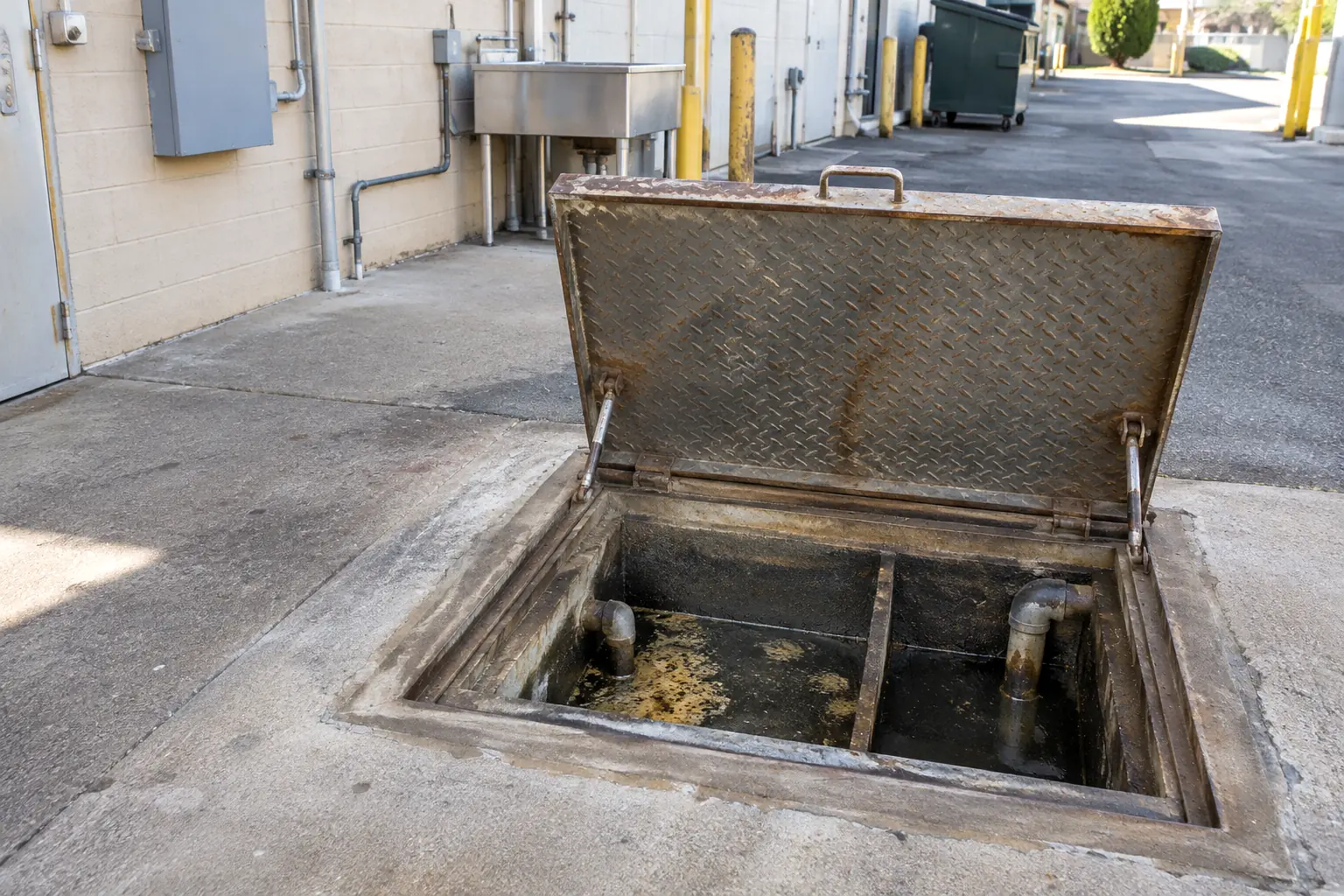
It depends on who owns the sewer your kitchen discharges into, and that is the part almost nobody tells you. One note on terms first: what most restaurant operators call a grease trap is what Anne Arundel County and the City of Annapolis call a grease interceptor, and this page uses the regulators’ word wherever it is quoting them.
Anne Arundel County’s FOG program publishes no pumping schedule at all, only a condition: once the oil and fat layer reaches 25 percent of the tank, the county requires pumping by a certified liquid waste hauler. The City of Annapolis runs its own pretreatment program under City Code Chapter 16.16, and its food handling application states a minimum cleaning frequency of every six months. Same geography, two different rulebooks. This guide covers which one applies to you, how each measures a full tank, the reporting paperwork your hauler owes the county, and what enforcement actually looks like.
Are you a county sewer customer or a City of Annapolis customer?
Settle this before anything else on this page is useful to you.
Anne Arundel County’s Department of Public Works runs a pretreatment program covering establishments that discharge into the county sewer system. The City of Annapolis regulates discharges into the City’s sanitary sewer system under Annapolis City Code Chapter 16.16 Article II, and publishes its own application, its own measurement guidance and its own cleaning logs.
If your restaurant is inside Annapolis city limits, start with the city’s materials. If you are in Glen Burnie, Severna Park, Millersville, Odenton, Crofton or elsewhere on county sewer, the county’s FOG program is your rulebook. If you are not certain which system serves your building, that is a question for your utility before it is a question for your hauler, and it changes the answer to everything below.
The rest of this page labels every requirement by jurisdiction. Where one publishes something the other does not, that is noted rather than blended.
How often does each jurisdiction require pumping?
Anne Arundel County publishes no frequency. The Department of Public Works states the requirement as a condition: “If a Grease Interceptor has an oil and fat layer making up to 25% of the tank users will be required to have the interceptor pumped by a certified liquid waste hauler.” That is a trigger to pump, not a date on a calendar.
The City of Annapolis publishes a minimum. Its food handling establishment pretreatment application asks how often the grease interceptor is cleaned and states, “The minimum is every six months.” The same application requires a copy of the grease interceptor servicing contract to be attached, and states that all interceptors shall be maintained at a level to meet the 100 mg/liter discharge limit. The city’s maintenance guidance adds that once a maintenance frequency has been established, the interceptor must be maintained at that frequency unless the Pretreatment Program is consulted.
So the widely repeated claim that Maryland has a flat 90 day rule does not match either document. What it misses is more interesting than a single interval: one jurisdiction regulates by condition, the other by a floor you cannot drop below without talking to them first.
There is also the plumbing code, which applies regardless of utility. The 2015 International Plumbing Code, adopted by the county, requires at section 1003.10 that interceptors and separators “be maintained by periodic removal of accumulated grease, scum, oil, or other floating substances and solids deposited in the interceptor or separator,” and that access be provided for service and maintenance. The code requires periodic removal. It does not name an interval, which is why the interval has to come from your utility, your permit and your actual accumulation rate.
What counts as a full grease trap, and who says so?
The two jurisdictions describe the threshold differently, and only one of them publishes a method.
The county names 25 percent of the tank and states that inspectors assess solids, the depth of the grease cap, and the volume of floating oils. It does not publish how the 25 percent is calculated, so whether it is figured against tank volume or liquid depth, and how settled solids count, is not something you can look up. If your tank runs near the line, call the pretreatment program at 410-222-8818 and ask before an inspector measures it for you.
The City of Annapolis does publish a method. Its grease interceptor maintenance guidance combines the floating grease and the settled solids and divides that by the depth of the interceptor contents, and states that when the interceptor reaches 25 percent capacity it needs pumping. The city adds a separate specification: a grease interceptor “should never have a solid layer or grease layer greater than 4 inches.”
The city’s method is evidence of the city’s method. It is not proof that the county calculates it the same way, so do not carry one across to the other.
What follows from either version is the same practical point. Grease accumulates from both directions, building a cap on top while solids settle below, so a tank can look serviceable from the lid and still be well down on working volume. Have your hauler record the grease and solids depths at each visit rather than just the date. Those readings are the only honest basis for setting an interval, and they are what a measured schedule is built from.
How often does the county actually inspect?
There is no fixed frequency for commercial users, in the county’s own words. Its pretreatment program describes four inspection types: initial or pre-permitting, routine, spill response and complaint response, and states that commercial users may be inspected initially at the time of permitting or at random.
One qualifier for larger operations. The county’s permit categories are not all alike, and significant industrial users and non-significant industrial users carry their own inspection frequencies. A large hotel or institutional kitchen may not be classified as an ordinary commercial user, which changes whether you have a schedule at all. If you do not know your category, it is worth confirming.
What paperwork does this generate?
More than most operators expect, and a meaningful share of it is your hauler’s job rather than yours.
Your permit. Every commercial establishment discharging into the county sewer system must apply for a Wastewater Discharge Permit. For grease interceptor and oil separator users the county publishes a $100 permit fee plus a $100 administrative fee. Permits run five years, with renewals due 180 days before expiration. City customers apply through the City of Annapolis instead, and the city’s application requires the servicing contract attached.
Your records. The county requires records of compliance with the County Plumbing Code to be kept for three years and made available on request by a county representative. Since requests arrive during inspections you did not schedule, keep them on site.
The Grease Interceptor Inspection Report. This is the one that surprises people. Anne Arundel County’s Liquid Waste Haulers Requirements, effective July 1, 1999, requires a Grease Interceptor Inspection Report from anyone cleaning, maintaining or pumping a grease interceptor in the county. The form must be filled out during the pumping or cleaning and signed by a facility representative. A copy goes to the facility that owns the interceptor, and a copy to the county Department of Public Works. Completed forms must be forwarded to the county on or before the 15th and 30th of each month.
Two things follow from that. A representative of your business has to be present and available to sign at the time of service, so a pump out nobody attends is a problem. And you should be receiving your copy every time, because it is the document that shows the work happened.
The same county guidance sets how the work is done: grease interceptors must be pumped completely void of all contents, every compartment of a multi-compartment tank must be pumped completely, and liquids may not be pumped back into the tank. If a hauler pumps the top layer and returns the liquid, that is not what the county document describes.
The file we keep for customers, on top of the county’s requirements above:
- The current discharge permit, with a reminder set 210 days ahead of expiration so the 180 day renewal window is not missed.
- Every Grease Interceptor Inspection Report, signed, going back three full years.
- Grease cap and solids depths at each service, so the interval is set by data rather than habit.
- The disposal destination for each load.
- Your interceptor’s size and installation date, and any approval letter for an interior grease recovery unit.
- A one page log of any backup, slow drain or odor event and what was done about it.
Items 1 and 2 and the three year retention come from the county. The rest is ours.
What does enforcement actually look like?
The county has not published a statement that a grease reading above the threshold is by itself a citable violation. What it has published is the enforcement framework that applies to pretreatment violations generally, and it is worth knowing the shape of it.
It starts with a Notice of Violation, generated within a week of a violation being discovered, giving 10 to 30 days from receipt to investigate, correct and respond. Failing to respond in that window is treated as a separate violation.
| Where it goes from there | What the plan publishes |
|---|---|
| Civil fines | $1,000 first violation, $5,000 second, $10,000 third or subsequent. Each day a violation exists is a separate civil offense |
| Civil citation | Caps at $1,000. Larger amounts require a complaint for injunction filed in court |
| Administrative Order | Generally used in response to significant non compliance |
| Loss of service | Permit suspension or revocation; separately, termination of service is the remedy the plan attaches to a commercial user’s failure to renew a permit |
| Public listing | Dischargers in significant non compliance are published annually in the local newspaper |
Anne Arundel County Department of Public Works, Pretreatment Enforcement Response Plan, last reviewed October 2017. Confirm it remains current before relying on specific figures. Suspension of sewer service is written about industrial users; a restaurant is normally a commercial user, which is why the permit renewal row is the one to put a calendar reminder against.
For an independent restaurant, the annual newspaper listing often lands harder than the fine does.
Who is licensed to pump a grease trap in Anne Arundel County?
The county answers this directly, in a document that is easy to miss. Its Liquid Waste Haulers Requirements states that the guidelines apply, in accordance with the Anne Arundel County Liquid Waste Hauler License, to all persons engaged in the business of cleaning, maintaining or pumping septic tanks and grease interceptors in the county. The license page itself is written around septic tanks and sewage disposal facilities and does not mention grease, which is why this gets misread, but the hauler requirements document connects the two explicitly.
The license is issued per truck rather than per company and expires May 1 each year. A separate application goes in for each vehicle. New registration is $50, renewal received on or before April 1 is $25, and a re-issuance after that date is $50, each with a $150 Health Department inspection fee. The county requires an insurance certificate with limits not less than $100,000 for property damage and $300,000 general liability, plus workers compensation, and the hauler must notify the department within 10 days if a policy is canceled. Questions about a specific truck go to the License Division at 410-222-7788.
For you as the operator, the useful version is short. Ask which county license the truck in your alley holds, make sure a representative of yours signs the inspection report at the time of service, and keep your copy. An out of area outfit that found you through a search result may not have a county licensed truck to send, and may not be filing the twice monthly reports the county expects.
What does a pump out cost?
Scardina’s standard rate for a routine grease pit pump out is $500. What that covers depends on tank size, access and condition, so a tank that has been left well past its interval or is difficult to reach is quoted on what it actually takes, and we tell you before the truck arrives rather than after. We publish our own number because a national average would tell you nothing about this market. Ask us to confirm the figure against your specific tank.
For context on the other side of the ledger, the EPA reported in 2012 that grease from restaurants, homes and industrial sources is the most common cause of reported sewer blockages at 47 percent, and that grease trap waste ranges from 800 to 17,000 pounds per year per restaurant. Those are national figures from EPA’s report to Congress on sewer overflows, not county ones.
If a line downstream of your kitchen has already started running slow, that is a drain problem with a likely cause, and the grease trap is where to look first.
Get a Straight Assessment from Scardina Home Services
The right interval for your kitchen is a measured number, not a guess, and it depends on which utility you are on, what your permit says and how fast your tank actually fills. Ask us to look at your grease trap’s history and current condition and talk through what a sensible schedule looks like for your operation. We are a licensed Anne Arundel County liquid waste hauler and handle grease trap service for restaurants, hotels and institutional kitchens across the area.
Call us at 410-761-6900 or request a free estimate online.
Scardina Home Services | 8082 Veterans Highway, Millersville, MD 21108 | 410-761-6900 | scardinahome.com/services/drain-cleaning/grease-traps
Scardina Home Services services grease traps and grease interceptors for restaurants, hotels and hospitality kitchens throughout central Maryland, including Annapolis, Arnold, Crofton, Crownsville, Gambrills, Glen Burnie, Lake Shore, Millersville, Odenton, Pasadena, Severn, Severna Park and Columbia, and the surrounding communities in Anne Arundel County.
Sources & References
- Anne Arundel County Department of Public Works, Commercial Establishments and FOGs. Accessed November 2026. https://www.aacounty.org/public-works/utilities/sewerwastewater-system/pretreatment-program/commercial-establishments-and
- Anne Arundel County Department of Public Works, Pretreatment Program. Accessed November 2026. https://www.aacounty.org/public-works/utilities/sewerwastewater-system/pretreatment-program
- Anne Arundel County Department of Public Works, Liquid Waste Haulers Requirements. Grease interceptor scope and inspection report, effective July 1, 1999. https://www.aacounty.org/sites/default/files/2023-04/Liquid%20Waste%20Haulers%20Requirements.pdf
- Anne Arundel County Department of Public Works, Pretreatment Enforcement Response Plan. Last reviewed October 2017. https://www.aacounty.org/sites/default/files/2023-04/Pretreatment%20Enforcement%20Response%20Plan.pdf
- Anne Arundel County, Liquid Waste Hauler License. https://aacounty.org/node/6712
- City of Annapolis, Food Handling Establishment Wastewater Discharge Pretreatment Application. Six month minimum cleaning frequency; City Code Chapter 16.16 Article II. https://www.annapolis.gov/DocumentCenter/View/1769/Food-Handling-Application-PDF
- City of Annapolis, Grease Interceptor Maintenance, Procedures, and Cleaning Logs. Measurement method, 25 percent capacity, 4 inch specification. https://www.annapolis.gov/DocumentCenter/View/21533/Grease-Interceptor-Maintenance-PDF
- 2015 International Plumbing Code, section 1003.10, Access and maintenance of interceptors and separators.
- US Environmental Protection Agency, Controlling Fats, Oils and Grease Discharges from Food Service Establishments, EPA-833-F-12-003, September 2012. The 47 percent figure is attributed within that document to EPA’s 2004 report to Congress on sewer overflows. https://www.epa.gov/system/files/documents/2021-07/pretreatment_foodservice_fs.pdf
Frequently Asked Questions
How often does Maryland require grease trap pumping?
There is no single Maryland answer, and the rule depends on your sewer utility. Anne Arundel County’s FOG program publishes a condition rather than a schedule. The City of Annapolis food handling application states a minimum cleaning frequency of every six months. Check which system serves your building.
What is the 25 percent rule for grease traps?
Anne Arundel County states that an interceptor with an oil and fat layer making up to 25 percent of the tank must be pumped by a certified liquid waste hauler, but does not publish how the 25 percent is measured. The City of Annapolis publishes its own method, combining grease and solids over the depth of interceptor contents.
Does the City of Annapolis have different grease trap rules than the county?
Yes. Annapolis regulates discharges to the City sanitary sewer under City Code Chapter 16.16 Article II, with its own application, measurement guidance and cleaning logs, including a six month minimum cleaning frequency and a specification that grease or solid layers should never exceed 4 inches.
Who can legally pump a grease trap in Annapolis or Anne Arundel County?
Anne Arundel County’s Liquid Waste Haulers Requirements apply the county Liquid Waste Hauler License to anyone cleaning, maintaining or pumping septic tanks and grease interceptors in the county. Licenses are issued per truck and expire May 1 annually. Ask which license the truck servicing you holds.
What is a Grease Interceptor Inspection Report?
A county required form, in effect since July 1, 1999, that the hauler completes during the pumping or cleaning and a facility representative signs. One copy goes to the facility, one to the Department of Public Works, and completed forms are forwarded to the county on or before the 15th and 30th of each month.
What size grease trap does Anne Arundel County require?
A minimum of 500 gallons for any establishment discharging fats, oils and grease into the county collection system, located outside the building and accessible for servicing. Interior grease recovery units may be allowed in some circumstances after receiving approval from the Department of Public Works.
How often does Anne Arundel County inspect grease traps?
There is no fixed frequency for commercial users. The county lists four inspection types: initial or pre-permitting, routine, spill response and complaint response, and states commercial users may be inspected at permitting or at random. Other permit categories carry their own frequencies.
How long do I have to keep grease trap service records?
Anne Arundel County requires records of compliance with the County Plumbing Code to be kept for three years and made available on request. Keep your signed Grease Interceptor Inspection Reports with them, on site rather than with your hauler, since requests arrive during unscheduled inspections.
What does the plumbing code say about grease trap maintenance?
The 2015 International Plumbing Code, at section 1003.10, requires interceptors and separators to be maintained by periodic removal of accumulated grease, scum, oil and solids, and requires access for service and maintenance. It calls for periodic removal without naming an interval.
Does a slow drain mean my grease trap is full?
Often, though not always. A slow drain downstream of a kitchen is one of the first symptoms of a grease trap at or past its threshold, but it can also point to a problem further out in the line. If the trap has not been checked recently, start there before anyone runs a cable.