
If you’ve started researching water heater replacements recently, you’ve probably encountered the term “heat pump water heater” — and possibly walked away more confused than when you started. The marketing materials talk about 300% to 500% efficiency and annual savings in the hundreds of dollars. The forums have homeowners in cold climates warning about freezing basements. The price tags are significantly higher than a standard tank. And none of it quite adds up into a clear picture of whether this thing is right for your specific home.
This post is the honest version of that explanation — how a hybrid heat pump water heater actually works, what it saves, what it requires in terms of space and installation, what the real tradeoffs are for a central Maryland home specifically, and how to know whether it makes sense for your situation.
How a Hybrid Heat Pump Water Heater Actually Works
The name is the starting point for most of the confusion, so let’s clear it up first.
A standard electric water heater uses resistance heating — essentially the same principle as a toaster. Electricity flows through heating elements inside the tank, and that direct electrical resistance generates heat. It’s simple, reliable, and 100% efficient in the sense that all the electricity you put in becomes heat. But it takes a lot of electricity to heat water this way.
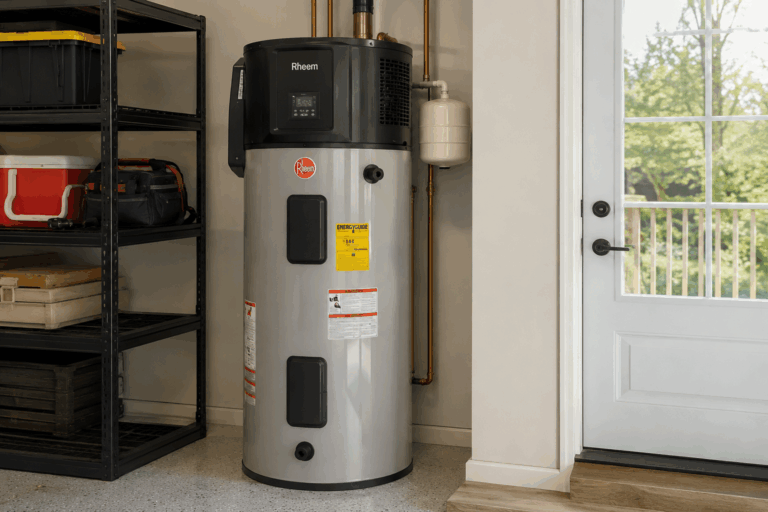
A heat pump water heater works on a completely different principle. Think of how an air conditioner removes heat inside your home and releases it outside. A hybrid water heater works like a reverse air conditioner. It pulls heat from the air around it and transfers it into your water tank. A. O. Smith
The physics of this matter: moving heat that already exists requires far less energy than generating heat from scratch. Heat pump water heaters use 2 to 4 times less electricity than a conventional electric resistance water heater because they move heat rather than generate it. Cleanenergycalc
The “hybrid” part of the name refers to the fact that most residential units combine the heat pump with traditional electric resistance backup elements. Hybrid models are designed to operate in either heat pump mode — the most energy-efficient mode — or as a conventional water heater with built-in resistance heating elements. In a real-world setting, a hybrid model utilizes the heat pump until it senses it is not keeping up with demand, at which point the electric resistance heaters kick on. Consumer Reports
This is what makes these units practical for real households. The heat pump mode handles the vast majority of daily hot water heating at high efficiency. When you have a lot of people showering back to back or guests in the house, the backup elements ensure you don’t run out of hot water.
Operating Modes
Modern hybrid heat pump water heaters offer several modes that homeowners can select based on circumstances:
Energy Saver / Hybrid mode is the default and the most efficient setting for everyday use. The system prioritizes heat pump operation and only activates the electric elements when needed to keep up with demand.
Heat Pump Only mode maximizes efficiency by running exclusively on heat pump technology. Best for households with consistent, moderate hot water use and warm ambient conditions around the unit.
High Demand mode runs the heat pump and electric elements simultaneously to heat the tank faster — useful during periods of heavy use like holidays or when you have a house full of guests.
Electric mode operates exactly like a traditional electric water heater. Rheem recommends Electric mode for use only when ambient temperatures drop below 37°F, or as a backup if the heat pump is unavailable. The unit will automatically revert to the default Energy Saver mode after 72 hours to prevent unnecessary energy consumption. Rheem
Vacation mode reduces the setpoint temperature while you’re away, minimizing energy consumption without letting the water go cold entirely.
What You’ll Actually Save
The efficiency claims on heat pump water heaters are real — but the actual savings depend on what you’re replacing, your household size, and your local electricity rates.
A.O. Smith hybrid heat pump water heaters have a Uniform Energy Factor between 3.0 and 4.0, compared to a UEF of around 0.93 for conventional tank water heaters. In plain terms: a heat pump water heater produces three to four units of heat energy for every unit of electrical energy it consumes. A standard electric water heater produces roughly one unit of heat for every unit of electricity. That difference is where the savings come from. A. O. Smith
The EPA’s Energy Star program estimates that a family of four can save approximately $550 per year with a heat pump water heater that has an Energy Star rating, compared with a standard electric water heater. Some manufacturers put that figure higher — A.O. Smith states their units use 70% less electricity than traditional electric models, saving up to $600 each year in operating costs. Consumer ReportsA. O. Smith
An important caveat: these savings figures compare a heat pump water heater to a standard electric resistance water heater. If you’re currently on a gas water heater — which is common in central Maryland homes — the math is different because gas and electricity are priced differently. In most cases, a heat pump water heater will still save money compared to gas over its lifetime, but the payback period is longer and depends heavily on your local utility rates. This is worth calculating specifically for your situation before making the decision.
The payback period. Heat pump water heaters cost more upfront than standard electric water heaters. You typically get your money back in three to six years through energy savings. Units generally last 10 to 15 years — meaningfully longer than the 8 to 12 year average for standard electric tanks — which means after payback, you have years of net savings ahead of you. A. O. Smith
Tax credits and rebates. One important update for 2026: the federal IRA Section 25C tax credit of up to $600 for heat pump water heaters expired December 31, 2025 and is no longer available for new 2026 installations. If you installed a qualifying unit in 2025, you can still claim it on that year’s return. Income-qualified households may still access rebates through the HEEHRA program — check with your state energy office for current availability. Maryland utility companies also periodically offer rebates for efficient equipment, so it’s worth checking with BGE or your local utility before purchasing. Cleanenergycalc
Space Requirements: What Your Basement or Utility Room Actually Needs
This is where most homeowners hit their first real question — and where the answer is often better than they expect for central Maryland homes specifically.
Heat pump water heaters pull heat from the air around them, which means they need enough air volume to work with. A Rheem heat pump water heater requires access to at least 450 to 700 cubic feet of air space with proper ventilation. Some manufacturers specify higher minimums. A.O. Smith says its hybrid electric heat pump water heaters should be installed in a room that is at least 450 cubic feet. RheemConsumer Reports
To put that in practical terms: a room that’s roughly 10 by 10 feet with 8-foot ceilings contains 800 cubic feet. Most unfinished Maryland basements meet this requirement easily. If your current water heater is in a small, enclosed utility closet, that’s where the space requirement becomes a real constraint.
Basements are often the best location for a heat pump water heater. These spaces typically provide ample room, often well above the required cubic footage. They generally enjoy stable year-round temperatures within the optimal operating range and help isolate the minimal noise the unit produces, reducing disruption in living areas. Rheem
If your space is tight, some models can connect to ductwork to draw air from a different area or exhaust to a different space — but this adds installation complexity and cost.
The unit also produces condensate — water that condenses out of the air during the heat exchange process. You need a floor drain or a small condensate pump to move this water away. Most Maryland basements have a floor drain, but this is something to verify before installation. Arctic Heat Pumps
Physical clearance. Beyond air volume, the unit needs physical clearance on all sides for airflow and service access. Your installer will specify exact clearance requirements for the model you select.
Electrical requirements. Heat pump water heaters require a 240V dedicated circuit — the same type of circuit that serves a standard electric water heater. If your current water heater is electric, this circuit likely already exists. If you’re switching from gas, running a new 240V circuit is part of the installation project.
The Maryland Climate Angle: Summer Benefit, Winter Tradeoff
Central Maryland’s climate creates a specific dynamic for heat pump water heaters that’s worth understanding clearly.
The summer benefit is real and significant. Because the heat pump pulls heat from the surrounding air to warm the water, it cools and dehumidifies the air around it as a byproduct. In a Maryland summer — with basement humidity regularly elevated — one survey respondent noted: “I do not have to run my dehumidifier in the basement anymore.” The free cooling and dehumidification effect in a Maryland summer is a genuine, tangible bonus that adds value beyond the water heating efficiency. Energy Vanguard
The winter question is more nuanced — and less concerning than many homeowners fear. The most common concern is that pulling heat from basement air in winter will significantly cool the basement and increase heating costs. The research says the effect is smaller than most people expect.
According to Energy Star, heat pump water heaters drive minimal temperature reductions — an average of 2.3°F — and go largely unnoticed by homeowners, even in winter. Temperature drops were also found to return to normal within four hours of system operation. Energy and cost savings from using a heat pump water heater are found to offset any additional whole-home heating costs during winter months. ENERGY STAR
The key factor for Maryland homes is that central Maryland basements typically maintain temperatures in the 55 to 65°F range through winter — well above the 40°F minimum at which the heat pump operates efficiently. Heat pump water heaters operate best in spaces where surrounding air temperature remains at or above 40°F. Hybrid models will continue to make hot water even if surrounding air temperature dips below 40°F — they simply rely more on the electric backup elements at that point, which uses more energy but still produces hot water reliably. ENERGY STAR
Every 10°F drop in temperature reduces efficiency by around 10% — which means a Maryland basement at 55°F in January is still operating efficiently, just not at peak summer performance. The unit automatically adjusts its mode to compensate. Rheem
Where this matters most: if your water heater is in a very small, poorly insulated space that gets genuinely cold in winter — below 40°F — a heat pump water heater will spend more of its winter time in electric resistance mode, reducing the efficiency advantage. A plumber assessing your space can tell you whether this is a concern for your specific installation.
Noise: What to Actually Expect
Heat pump water heaters are not silent — they have a fan and a compressor, similar to an air conditioner or refrigerator. While you’ll hear some sound from the fan and compressor, it’s typically no louder than your refrigerator or dishwasher running. Many homeowners are pleasantly surprised by how quiet these units are, especially when installed in a basement. A. O. Smith
For most central Maryland homes where the water heater is in an unfinished basement away from living spaces, noise is rarely a practical concern. If your water heater is in a utility closet adjacent to a bedroom or main living area, it’s worth factoring in.
Is a Hybrid Heat Pump Water Heater Worth It for Your Maryland Home?
The honest answer is: for most central Maryland homeowners replacing an electric water heater with adequate basement space, yes — clearly. For homeowners switching from gas, it’s worth running the numbers on your specific utility rates first.
The case is strongest when:
- You currently have an electric water heater
- Your water heater is in a full, unfinished basement with adequate air volume
- Your household uses significant hot water — a family of three or more
- You plan to stay in the home long enough to capture the payback period (typically three to six years)
- You value the summer dehumidification bonus in a Maryland basement
The case is weaker or worth more careful evaluation when:
- You’re on natural gas and the switching cost is high
- Your water heater is in a very small, enclosed space that can’t meet air volume requirements without ducting
- Your basement gets genuinely cold in winter (below 40°F)
- Your household is very small with low hot water demand
What to do next: Have a licensed plumber assess your space — the air volume, the electrical situation, the drain location, and the installation complexity — before committing. The efficiency claims are real, but they’re contingent on a properly installed system in a space that can support how these units work.
Water Heater Services from Scardina Home Services
Scardina Home Services installs and services water heaters — including hybrid heat pump models — for homeowners throughout central Maryland, including Glen Burnie, Severn, Crofton, Gambrills, Odenton, Pasadena, Annapolis, Severna Park, Arnold, and the surrounding communities in Anne Arundel County.
If you’re evaluating whether a heat pump water heater makes sense for your home, we’ll give you a straight assessment of your space, your current setup, and the realistic costs and savings — before you make any decision.
Call us at 410.782.0937 or request a free estimate online.
Scardina Home Services | 8082 Veterans Highway, Millersville, MD 21108 | 410.782.0937 | scardinahome.com/services/water-heaters
Frequently Asked Questions
What’s the difference between a heat pump water heater and a hybrid water heater — are they the same thing?
Yes, in practice they’re the same product. “Hybrid” refers to the fact that the unit combines heat pump technology with traditional electric resistance backup heating elements. The heat pump handles most of the work under normal conditions, and the electric elements kick in when demand exceeds what the heat pump can supply or when ambient temperatures are too low for efficient heat pump operation. Manufacturers and contractors use the terms interchangeably, which contributes to the confusion. When you see either term in a product listing or quote, you’re looking at the same category of equipment.
Can I install a heat pump water heater where my current water heater is?
Usually yes — but it depends on a few things. If your current water heater is in an unfinished basement with reasonable square footage, you’re almost certainly fine on space. The main variables to check are air volume (the space needs at least 450 to 700 cubic feet of accessible air, depending on the model), the presence of a floor drain or condensate pump option for the water the unit produces, electrical capacity (you need a 240V dedicated circuit), and ceiling height (these units are taller than standard tanks). If you’re switching from gas, the electrical circuit is a new installation cost. If you’re currently electric, the circuit likely already exists. A plumber can assess your specific space in a few minutes before any commitment is made.
My water heater is in a small utility closet. Can I still get a heat pump water heater?
Possibly, but it requires more planning. A closed utility closet that doesn’t meet the minimum air volume requirements won’t allow the heat pump to operate correctly — it will either run inefficiently as it depletes the available heat in the confined space, or default to electric resistance mode most of the time, which eliminates the efficiency advantage you’re paying for. Some models address this with ductwork that draws air from an adjacent space and exhausts to another area, but that adds installation cost and complexity. If your closet is genuinely too small and ducting isn’t practical, a tankless or standard electric unit may be a better fit for your space than forcing a heat pump installation that won’t perform as intended.
Will it actually freeze my basement in winter?
This is the most common concern we hear, and the research is fairly reassuring. Studies of homes in cold climates have found that heat pump water heaters reduce surrounding air temperature by an average of about 2.3°F during a heating cycle, with temperatures recovering within a few hours. Most homeowners in those studies reported not noticing the temperature change. For central Maryland specifically, where unfinished basements typically hold temperatures in the mid-50s to low 60s through winter, the effect is even less pronounced than in colder northern climates. The unit doesn’t freeze your basement — it makes modest, temporary draws on the available heat in the space, which your home’s heating system compensates for with minimal additional energy use.
I’m on natural gas right now. Does it make sense to switch to a heat pump water heater?
It depends on your specific utility rates and how much hot water your household uses. The efficiency advantage of a heat pump water heater is most straightforward when you’re comparing it to a standard electric resistance water heater — that’s where the three to four times efficiency multiple produces the cleanest savings math. When comparing to gas, you have to account for the current price differential between electricity and natural gas in Maryland, plus the cost of running a new 240V electrical circuit if one isn’t already in place. In many cases, a heat pump water heater still comes out ahead over its lifetime — but the payback period is typically longer than when replacing an electric unit. This is worth calculating with your plumber before deciding, not assuming in either direction.
How loud is it? I’ve heard these units are noisy.
Older models and some budget units have more noticeable noise. Current models from major manufacturers run at roughly the sound level of a refrigerator or dishwasher — audible if you’re standing next to it, but not disruptive in an adjacent room. For the vast majority of central Maryland homes where the water heater is in an unfinished basement, this isn’t a practical concern. If your current water heater is in a utility space that shares a wall with a bedroom or main living area, it’s worth asking your plumber about sound ratings for the specific model being considered. Basement installations are generally the quietest because the concrete and distance buffer the sound naturally.
The federal tax credit expired — are there any other incentives still available?
The Section 25C federal tax credit for heat pump water heaters expired at the end of 2025 and is no longer available for new installations in 2026. Income-qualified households may still access rebates through the HEEHRA program at the state level — check with the Maryland Energy Administration for current availability and income thresholds. Additionally, BGE and other Maryland utilities periodically offer rebates for high-efficiency water heating equipment, and those rebate programs change throughout the year. Before purchasing, it’s worth spending a few minutes checking your utility’s current rebate offers — the amounts vary but can meaningfully offset the upfront cost difference between a heat pump unit and a standard electric tank.
How long will it last compared to a standard water heater, and what maintenance does it need?
Hybrid heat pump water heaters typically last 10 to 15 years — somewhat longer than the 8 to 12 year average for standard electric tank water heaters. The longer lifespan is part of the total cost of ownership calculation that makes them financially attractive despite the higher upfront cost. In terms of maintenance, the heat pump component has an air filter that should be checked and cleaned periodically — typically every few months — to ensure adequate airflow. Without that, the unit works harder than it should and efficiency drops. Beyond the filter, the annual plumbing inspection that any water heater benefits from applies here as well: checking connections, the temperature and pressure relief valve, and confirming the condensate drain is clear. Nothing dramatically more involved than a standard tank — just the one additional filter step.
What size unit do I need for my household?
Tank capacity for a heat pump water heater is sized similarly to a standard electric tank — based on household size and hot water usage patterns. A general starting point is 50 gallons for a household of two to three people and 65 to 80 gallons for four or more. The first-hour rating — how much hot water the unit can supply in the first hour of use starting from a full tank — is the more precise metric than tank size alone, and it matters more for households with concentrated morning hot water demand. Your plumber can size the unit correctly based on your household and usage patterns. Undersizing a heat pump water heater is a more common mistake than oversizing it, because the heat pump’s recovery rate is somewhat slower than a resistance-only element — a properly sized unit eliminates that concern entirely.
Have questions about whether a heat pump water heater makes sense for your home? Call us at 410.782.0937 or reach out online at scardinahome.com/estimate-service — we’re happy to assess your space before you commit to anything.