
Step outside in central Maryland on any April morning and you already know it’s happening. The yellow-green dust coating your car, your porch furniture, your windows — that’s oak, maple, and birch pollen, and it’s absolutely everywhere right now. What most homeowners don’t realize is that the same pollen blanketing every surface outside is working its way through your HVAC system around the clock, clogging your filter, coating your coils, and quietly driving up your energy bills before summer even starts.
This isn’t a problem you’ll see coming. By the time your system shows obvious symptoms — weaker airflow, longer run times, rooms that won’t cool evenly — the damage from a season of pollen neglect is already done. Here’s what’s actually happening inside your system right now, and what to do about it before you need your AC for real.
Why April Is the Worst Month for Maryland HVAC Filters
Maryland’s spring pollen season doesn’t ease you in — it hits hard and fast. The most common Maryland allergy triggers in spring are tree pollen from oak, maple, birch, cedar, and pine trees, which release pollen in February, March, and April. Cac-hc
In Maryland, you’ll want to keep a close eye on pollen counts in April — it’s one of the worst months for seasonal allergies in the state, when tree pollen is at its absolute peak. Wyndly
According to the Asthma and Allergy Foundation of America’s 2025 Allergy Capitals Report, growing seasons now start earlier and last longer than they did just 30 years ago due to climate change, and warmer temperatures stimulate increased pollen production. The Banner For central Maryland homeowners, that means pollen season is no longer a brief inconvenience — it’s an extended assault on your home’s air filtration systems.
For the Baltimore and Annapolis areas specifically, the primary sources of spring tree pollen are oak, hickory, ash, and maple Wyndly — all heavy producers that send microscopic particles airborne for weeks at a time. Your HVAC system is running through all of it.
What Pollen Actually Does to Your HVAC System
It Clogs Your Filter — Faster Than You Think
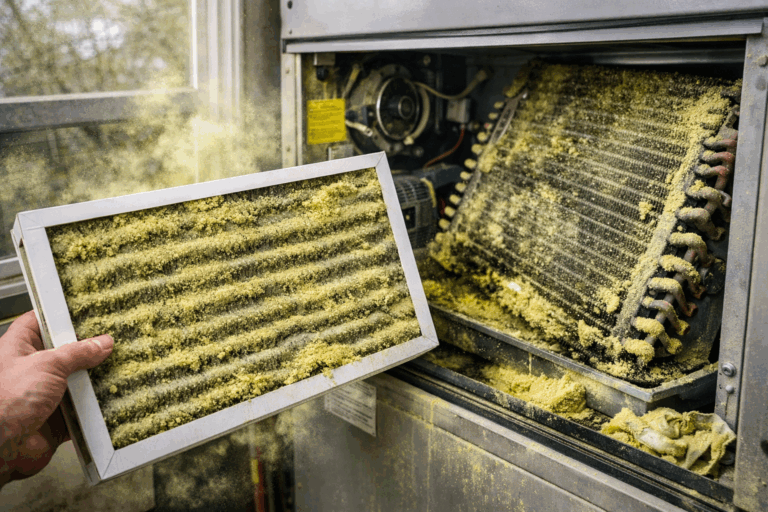
Your air filter is the front line of defense for your entire HVAC system. Under normal conditions, a standard filter might last 60–90 days before needing replacement. During peak pollen season in Maryland, that timeline collapses.
During high pollen seasons, filters become clogged much more quickly, reducing their effectiveness. This leads to decreased indoor air quality and increased strain on the HVAC system. HVAC Laboratory
When filters are clogged, your system has to work harder to circulate air, leading to increased energy consumption and higher utility bills. City Heat and Air What feels like a filter that just needs changing is actually a system already working overtime every time it kicks on.
The fix is simple — but only if you act before the filter is completely saturated. According to the Department of Energy, replacing an air filter clogged with pollen with a new, clean filter can improve your air conditioner’s energy efficiency by 15%. Fulbro
It Coats Your Evaporator and Condenser Coils
A clogged filter is the first problem — but it’s not the only one. Pollen that makes it past or around your filter doesn’t just disappear. It settles on the internal components of your system, and that’s where real mechanical damage begins.
The air filter’s job is to keep debris off the evaporator coil. If the coil has buildup, the air conditioner’s refrigerant can’t transfer heat or humidity out of your home effectively. Fulbro
If pollen settles on the condenser coil — the outdoor unit — the system will struggle to release heat, causing your air conditioner to overheat, shut down, or suffer serious damage. NEXGEN HVAC That outdoor unit sitting next to your home’s landscaping right now is being hit with pollen every single day, and most homeowners never think to rinse it off.
Even a thin layer of pollen and debris can form a coating that increases air friction, forcing your AC to work harder and preventing the unit from cooling your home efficiently. NEXGEN HVAC
It Gets Into Your Ductwork
Pollen that enters your system doesn’t just affect the filter and coils. Pollen grains can still circulate and eventually settle in your ductwork, where they reenter the air supply every time the AC turns on. NEXGEN HVAC This is why homeowners who change their filters diligently still sometimes find their allergy symptoms worse than expected indoors — the ductwork becomes a pollen reservoir that keeps recirculating what’s already been captured.
It Accelerates Wear and Tear
An HVAC system struggling with clogged filters and poor airflow experiences more strain and is likely to suffer from wear and tear at an accelerated rate. City Heat and Air Think about what this means for a system that’s about to face its heaviest workload of the year. A system going into summer already stressed by a pollen-saturated filter is a system far more likely to fail in July — when you need it most and HVAC technicians are busiest.
The Indoor Air Quality Problem
Here’s the dimension of this issue that often gets overlooked: a pollen-overloaded HVAC system isn’t just a mechanical problem — it’s a health problem for everyone inside the home.
When your HVAC filter is overwhelmed by pollen, it can no longer effectively trap other particulates, leading to poor indoor air quality. This can exacerbate allergies and respiratory conditions such as asthma. City Heat and Air
The Maryland Department of Health has noted that higher pollen levels increase emergency department visits and inpatient hospitalizations due to asthma, hay fever, and other respiratory diseases. Maryland Health Your home is supposed to be a refuge from outdoor pollen — but a neglected HVAC system turns it into a recirculation machine for the very particles making you miserable.
This matters especially for central Maryland families with children, elderly residents, or anyone with asthma or allergic rhinitis. Your HVAC system either protects your indoor air or compromises it — there’s no neutral.
What You Should Be Doing Right Now
Change Your Filter Monthly During Pollen Season
This is the single most important thing you can do. During peak pollen season, which extends from March through October in Maryland, plan to check and replace your HVAC air filter once each month. Fulbro If you have pets, allergic family members, or an older system, checking every two to three weeks during April and May is not excessive — it’s appropriate.
Pull the filter out right now and look at it. If it’s gray, packed with visible debris, or you can’t see light through it, it needed changing already.
Upgrade to a Higher MERV-Rated Filter
Not all filters are equal when it comes to pollen capture. Basic fiberglass filters trap large particles but let pollen pass through. For spring, upgrade to high-efficiency filters with a MERV rating of 11–13 to capture smaller pollen particles effectively. Purolator Air Filters
A word of caution here: filters with very high MERV ratings (above 13) can actually restrict airflow in systems not designed for them, adding strain rather than relieving it. A licensed HVAC technician can tell you the highest appropriate MERV rating for your specific system.
Rinse Off Your Outdoor Condenser Unit
Your outdoor unit is sitting in the middle of Maryland’s pollen storm every day. Rinsing the outdoor unit with a garden hose at medium pressure can wash away pollen and particles so they don’t cause problems. Trim vegetation a few feet away on each side to prevent plants from blowing pollen directly into the unit. NEXGEN HVAC This is a simple five-minute task that most homeowners skip entirely — and that most HVAC technicians wish they didn’t.
Keep Windows Closed on High-Pollen Days
It feels counterintuitive on a beautiful April morning, but opening your windows during peak pollen hours (morning through early afternoon) defeats everything your HVAC filtration system is trying to accomplish. Keep windows closed during high pollen count days to reduce the burden on your filter Purolator Air Filters and let your system do its job without fighting a constant influx of new particles.
Schedule a Spring HVAC Tune-Up
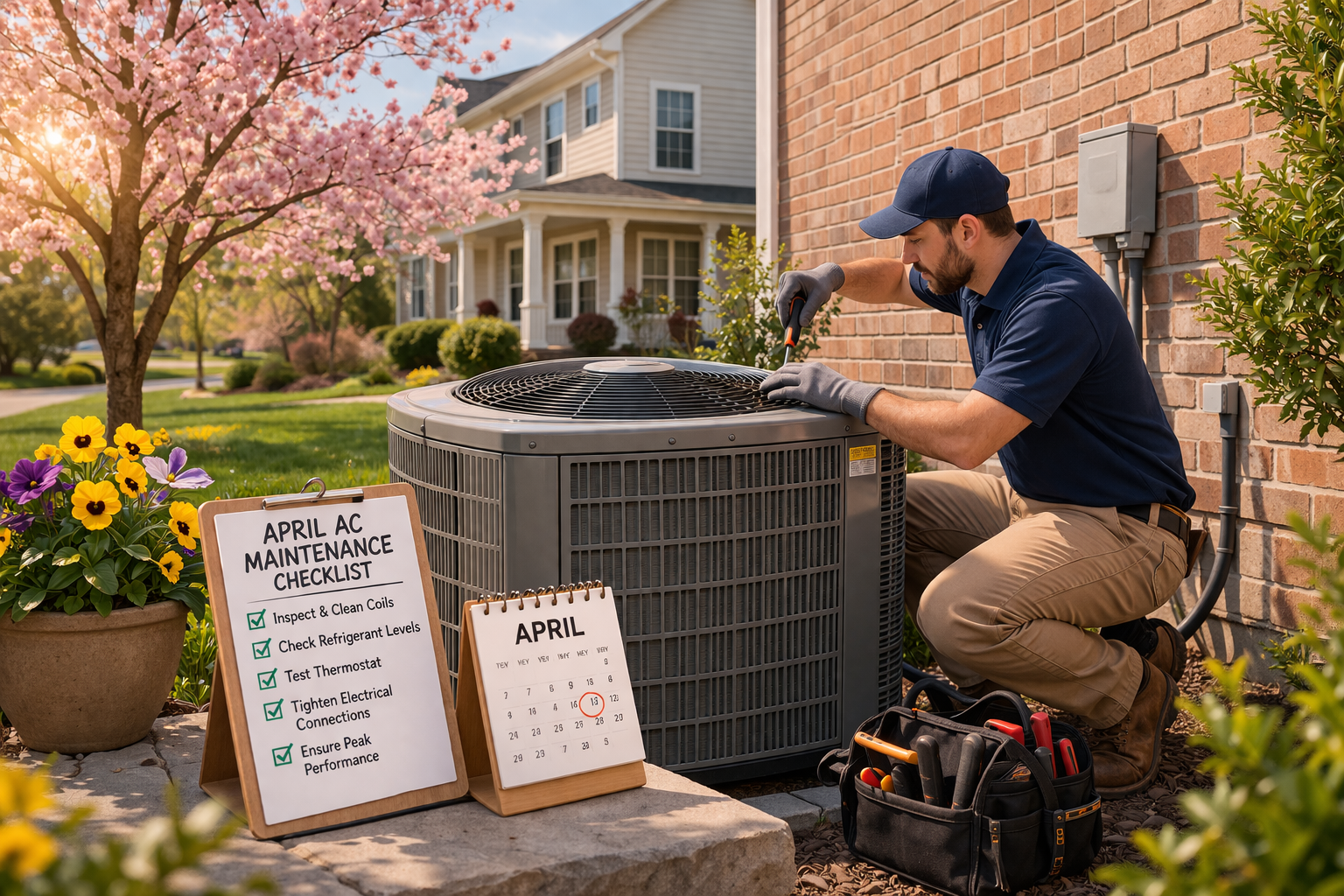
April is the ideal time for a professional HVAC inspection — before you’re relying on the system daily for cooling and before every HVAC company in Maryland is booked out for weeks. A technician will clean the evaporator and condenser coils, check refrigerant levels, inspect the blower and ductwork, and ensure your system is ready to handle both the remaining pollen season and the summer ahead.
Watch for signs that pollen might already be affecting your AC: a constant need to adjust the thermostat, unusual noises, a decrease in cooling efficiency, or an unexplained spike in your energy bill. These are indicators that pollen could be causing a problem that needs professional attention. Tristateheating
The Bottom Line for Central Maryland Homeowners
April’s pollen season isn’t just hard on your sinuses — it’s hard on your HVAC system. Every day your filter goes unchecked during peak tree pollen season in Maryland is another day your system is working harder, cooling less efficiently, and circulating more allergens through your home. The good news is that pollen-related HVAC problems are almost entirely preventable with simple, timely maintenance.
Change your filter now. Rinse off your outdoor unit. And if your system hasn’t had a professional tune-up yet this spring, don’t wait until June to find out it has a problem.
📞 Ready to Get Your HVAC System Spring-Ready?
Scardina Home Services installs, services, and repairs nearly all heating and cooling equipment — all makes and all models throughout central Maryland. Whether you need a spring tune-up, a coil cleaning, or a full system inspection before the summer heat arrives, our team is ready.
Our HVAC services include:
- Spring AC tune-ups and inspections
- Coil cleaning and system maintenance
- Filter upgrades and indoor air quality assessments
- HVAC repair and replacement for all makes and models
Don’t wait until the heat hits and every HVAC company is backed up for weeks.
📱 Call Us: 410.782.0937 | 💻 Request Service Online
Serving Millersville, Annapolis, Baltimore, and communities throughout central Maryland.
Frequently Asked Questions
How often should I change my HVAC filter during Maryland’s spring pollen season?
At minimum, once a month from March through May. During peak weeks in April when tree pollen counts are at their highest, check it every two to three weeks. A clogged filter during pollen season restricts airflow, drives up your energy bills, and sends allergens back through your home every time the system runs.
What MERV rating filter should I use during pollen season?
For most Maryland homes during spring, a MERV 11–13 filter offers the best balance of pollen capture and proper airflow. Basic MERV 1–4 fiberglass filters let pollen pass through, while very high-rated filters (MERV 16+) can restrict airflow in systems not designed for them. If you’re unsure what rating your system can handle, a quick call to an HVAC technician will get you the right answer.
Can pollen get into my ductwork even if I change my filter regularly?
Yes. Some pollen bypasses or works around filter edges, particularly if the filter isn’t seated perfectly or if there are gaps in the return air housing. Once inside the ducts, pollen settles on interior surfaces and gets recirculated every time the system runs. If you have persistent allergy symptoms indoors despite regular filter changes, a duct inspection is worth considering.
Should I rinse off my outdoor AC unit during pollen season?
Absolutely. A gentle rinse with a garden hose every few weeks during peak pollen season removes the layer of pollen and debris coating your condenser coils. Avoid high-pressure settings that can bend the fins, and turn the power off at the disconnect box before spraying. This is one of the easiest and most overlooked maintenance tasks a homeowner can do.
Why does my home feel more stuffy or my allergies seem worse when the AC is running?
If your filter is saturated with pollen, your system stops filtering and starts recirculating. A clogged filter can no longer effectively trap additional particles, so everything that was caught gets pushed back out when the system kicks on. Change the filter, and if symptoms persist, schedule an inspection — pollen may have built up on the coils or in the ductwork.
Is it worth getting a professional spring tune-up just for pollen-related issues?
Yes — but a spring tune-up covers far more than just pollen. A technician will clean the coils, check refrigerant levels, inspect electrical connections, test the blower, and make sure the entire system is operating at peak efficiency heading into summer. Catching a minor issue in April is dramatically cheaper than dealing with a breakdown in July. Contact Scardina at 410.782.0937 or request service online to get on the schedule now.