
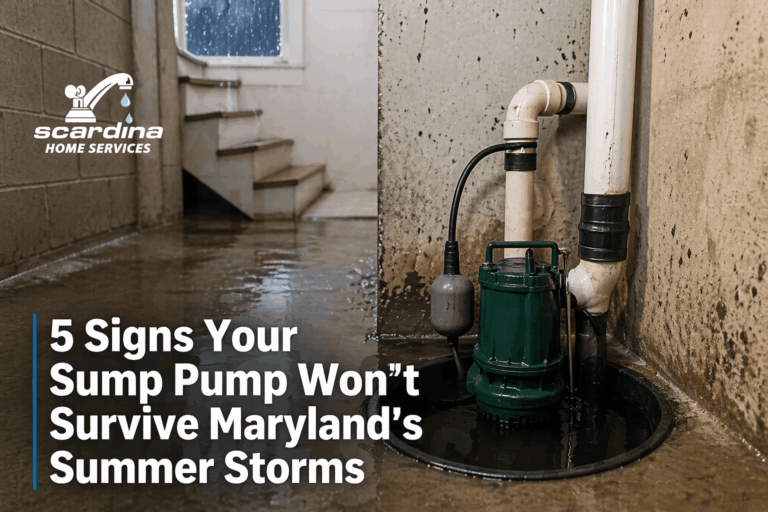
The Thing in Your Basement That You Never Think About
Somewhere in your basement — tucked in a corner, covered by a lid, maybe surrounded by storage bins you haven’t opened in years — there’s a pump that stands between your home and thousands of dollars in water damage.
Most Maryland homeowners don’t think about their sump pump until the moment they desperately need it. And that moment almost always arrives the same way: in the middle of a summer thunderstorm, at night, when the power is flickering and water is finding its way in faster than anyone expected.
Flooding is the most common natural hazard in Anne Arundel County. Anne Arundel County Summer in central Maryland means intense heat, humidity, and the kind of fast-moving thunderstorms that can drop several inches of rain in a matter of hours. Anne Arundel County regularly appears on National Weather Service flood watches alongside Baltimore City and surrounding counties when these storm systems move through. The Banner
Your sump pump is the last mechanical line of defense against all of it. The question is whether yours is actually ready.
What a Sump Pump Does — and Why It Matters So Much Here
A sump pump sits in a pit dug at the lowest point of your basement floor. As groundwater and storm runoff seep into that pit, a float switch detects the rising water level and activates the pump, which pushes the water through a discharge line and away from your foundation. When it’s working correctly, this all happens automatically and invisibly. When it fails — especially during a significant storm — the consequences are immediate and expensive.
Basement water damage restoration typically averages between $5,000 and $25,000 depending on severity. National Today That’s before accounting for damaged furniture, electronics, flooring, finished walls, or sentimental items stored in the space. And making matters worse: standard homeowners insurance policies typically do not cover sump pump failure, even during a storm. Angi You would need a specific water backup endorsement on your policy to have any coverage — something most homeowners discover too late.
The pump itself is not expensive. A quality replacement and professional installation is a fraction of what a flooded basement costs to remediate. The problem is that most pumps fail silently, showing warning signs for weeks or months before the actual failure — signs that most homeowners never look for.
How Long Should a Sump Pump Last?
Before getting into the warning signs, it helps to understand the baseline. On average, a sump pump lasts 7 to 10 years, influenced by factors such as usage, maintenance, and system quality. Mr. Rooter Plumbing
For central Maryland homeowners, that lifespan pressure is real. A pump in a wet, low-lying area near the Chesapeake Bay watershed — where groundwater is consistently elevated and summer storms are frequent and intense — works significantly harder than one in a dry climate. Heavy usage accelerates wear on every mechanical component inside the unit.
If your unit is approaching or exceeding the 7–10 year range, it may be time for a replacement. Even if it’s working fine, the parts could be worn out — and it’s better to replace your sump pump before an issue arises that results in water damage. ARS
If you don’t know how old your pump is, that’s worth finding out before summer storm season arrives in earnest.
Sign #1: Your Pump Is 7+ Years Old and Has Never Been Serviced
This is the single most overlooked warning sign — not because it’s subtle, but because most homeowners simply don’t know their pump’s age or service history.
A pump that has never been professionally inspected, cleaned, or tested could be operating with a stuck float switch, a clogged inlet screen, a weakening motor, or a compromised discharge line — and none of that would be visible from the outside. The first indication of any of those problems would be water in your basement.
If you don’t maintain your sump pump regularly, you may not notice it’s malfunctioning until it stops working. Once it does, it can lead to expensive water damage to your home and belongings. American Family Insurance
The fix here is simple: if you don’t know when your pump was last serviced, schedule an inspection. Scardina Home Services can assess the age, condition, and capacity of your unit and tell you exactly where it stands before summer storms arrive.
Sign #2: You Hear Unusual Noises When It Runs
A properly functioning sump pump runs relatively quietly. If you’ve started noticing grinding, rattling, clanking, or gurgling sounds when the pump activates, those sounds are the motor telling you something is wrong.
Unusual noises — grinding, rattling, or gurgling sounds — may suggest motor issues or debris buildup. Mr. Rooter Plumbing Grinding specifically often points to a worn or damaged impeller — the component responsible for moving water through the pump. A compromised impeller reduces the pump’s ability to move water efficiently and places growing stress on the motor. StreetInsider
This matters enormously during a major storm, when the pump needs to run at full capacity for extended periods. A motor already under stress from a damaged impeller can burn out entirely at precisely the moment it’s being asked to work hardest.
If your pump is making noise it wasn’t making a year ago, that’s not something to monitor — it’s something to have evaluated immediately.
Sign #3: It Runs Constantly or Cycles On and Off Too Frequently
A sump pump that cycles on and off repeatedly — even when there’s no active rain event — is a pump under serious stress.
Excessive cycling, more than 2 to 3 times daily, can indicate the pump is struggling to keep up with water levels or experiencing mechanical issues, and it can also accelerate wear on the pump’s components. Sumppumpgurus
Constant cycling is most commonly caused by one of three things: a float switch that has shifted position and is triggering incorrectly, a sump pit that is undersized for the volume of water the home produces, or a failing check valve that is allowing discharged water to flow back into the pit — forcing the pump to immediately expel the same water it just removed.
In every one of these scenarios, the pump is working far harder than it was designed to, burning through its remaining service life with every unnecessary cycle. What might have lasted another few years under normal conditions can fail in a single heavy storm season if the root cause isn’t addressed.
Sign #4: You Notice Rust, Visible Corrosion, or Standing Water in the Pit
Take a few minutes to actually look at your sump pump. Remove the lid, shine a light into the pit, and look at the unit itself. What you find may tell you a great deal.
Visible rust or corrosion — especially flakes of it in the sump pit — indicates that the metal components are corroding. This corrosion will eventually compromise the pump’s integrity. Saffer Plumbing If you can see rust on the outside of the unit, there is almost certainly more corrosion you cannot see on the internal components.
Standing water in the pit when there has been no recent rain is also a red flag. It may indicate that the pump is not activating when it should, that the float switch has failed, or that the pump is running but not discharging water effectively. Water accumulation in the basement is the most obvious sign that a sump pump needs attention — if water is present, the pump isn’t functioning correctly and requires immediate evaluation. Oriolebw
Sign #5: Your Power Goes Out During Storms — and You Have No Battery Backup
This is the warning sign that catches the most Maryland homeowners off guard, because it has nothing to do with the mechanical condition of the pump itself.
A standard sump pump is hardwired to your home’s electrical system. The moment your power goes out — which, in central Maryland’s summer storm season, is not a rare occurrence — your sump pump stops working entirely. And the storms powerful enough to knock out power are almost always the same storms producing the most rainfall and runoff.
One of the most prevalent causes of sump pump failures is power outages. When storms or electrical malfunctions disrupt the main power supply, connected sump pumps are rendered ineffective, leaving basements vulnerable to flooding. magicplan
A battery backup sump pump is a secondary unit that activates automatically when the primary pump loses power or fails for any reason. It runs on a battery system — typically good for several hours of continuous operation — and provides critical protection during exactly the scenarios where your primary pump cannot function.
Power outages can cause surges that damage your home’s electric systems, including your sump pump. A battery backup power system with built-in surge protection can help protect the pump during these events. American Family Insurance
If you don’t currently have a battery backup and your home has a basement, this is one of the most cost-effective protective upgrades available.
The Hidden Risk: Storms That Overwhelm a Properly Functioning Pump
Even a pump in good mechanical condition can fail to protect your basement if it’s undersized for an extreme storm event. Your sump pit is likely sized for average annual rainfall in your location. When storms dump more water in less time than anticipated, it may be too much for your sump pump to handle. Angi
This is particularly relevant for Maryland homeowners, where summer convective storms can dump 2 to 3 inches of rain in under an hour. If your pump was sized for average conditions and your neighborhood has developed significantly in the years since installation — adding impervious surfaces like driveways, rooftops, and parking lots that funnel more runoff toward your foundation — it may simply be undersized for your current situation.
A professional inspection doesn’t just assess the pump’s mechanical condition. It evaluates whether the unit is appropriately sized for your home, your lot, and your local drainage conditions.
What a Pre-Season Sump Pump Inspection Covers
When Scardina Home Services inspects a sump pump system, we evaluate:
- Age and mechanical condition of the primary pump
- Float switch function — whether it activates at the correct water level and shuts off properly
- Inlet screen and pit condition — clearing debris that restricts water flow
- Discharge line integrity — confirming water is being directed away from the foundation and the line is free of blockages
- Check valve condition — verifying water isn’t flowing back into the pit after discharge
- Capacity assessment — confirming the unit is sized appropriately for your home’s drainage needs
- Battery backup status — assessing whether a backup system is present, functional, and appropriate
If your pump is approaching the end of its service life, showing any of the warning signs above, or has never been inspected, this assessment gives you the information you need to make a decision before a storm forces one for you.
Don’t Wait for a Storm to Find Out
The worst time to discover your sump pump has failed is during a thunderstorm at midnight with water rising in your basement. By that point, the damage has already begun.
The best time to act is now — before the height of central Maryland’s summer storm season, when scheduling is flexible, parts are available, and you’re making a planned decision rather than an emergency one.
Protect Your Basement Before the Next Storm
Scardina Home Services serves central Maryland homeowners across Glen Burnie, Severn, Millersville, Odenton, Crofton, Crownsville, Pasadena, Severna Park, Annapolis, and surrounding communities. Our licensed plumbing team can inspect your sump pump, identify any issues, and recommend the right solution — whether that’s a tune-up, a battery backup installation, or a full replacement.
📞 Call us at 410.782.0937 🌐 Schedule your inspection at scardinahome.com/estimate-service
Don’t wait for the water. Call Scardina today.
Frequently Asked Questions
How do I know if my sump pump is actually working right now?
The easiest way is to pour a five-gallon bucket of water slowly into the sump pit. As the water level rises, the float switch should activate the pump, which should then drain the pit quickly and shut off. If the pump doesn’t activate, activates but drains slowly, runs continuously after the pit is empty, or makes unusual noises during the test, there is a problem that needs professional evaluation. This test takes about five minutes and should be done at least once before summer storm season.
My sump pump is only 5 years old. Should I still be worried?
Age is one factor, but not the only one. A five-year-old pump that has run heavily through multiple storm seasons in a wet basement, was installed incorrectly, has never been serviced, or has no battery backup is at meaningful risk of failure. Conversely, a well-maintained pump in a drier basement may still have years of reliable service ahead. The warning signs described in this post — unusual noises, constant cycling, visible corrosion — are relevant regardless of age. If you’re not sure, an inspection will give you a definitive answer.
What does a battery backup sump pump cost?
Battery backup systems vary depending on the type, capacity, and brand, but they are generally far less expensive than the cost of a single basement flooding event. A professionally installed battery backup system from Scardina Home Services provides protection specifically during the storm scenarios most likely to cause flooding — when your power goes out. The best way to get an accurate number for your home is to request a free estimate.
How often should a sump pump be replaced in Maryland?
The general guideline is every 7 to 10 years, but in central Maryland — where summer storms are frequent and intense, groundwater levels are elevated near the Chesapeake Bay watershed, and humidity accelerates corrosion — proactive replacement at or before the 7-year mark is often the smarter call. Maryland pumps work harder than pumps in drier climates, which compresses their effective service window. If your pump is approaching that range, a professional inspection will tell you whether it has more life left or whether replacement now is the right move.
Will homeowners insurance cover my basement if the sump pump fails?
In most standard homeowners insurance policies, the answer is no. Damage caused by sump pump failure is typically excluded unless you have specifically added a water backup endorsement to your policy. Even with that endorsement, the coverage often applies to the resulting damage — not the cost of replacing the pump itself. This is one of the primary reasons proactive maintenance and timely replacement matter so much. Preventing the failure is always less expensive than managing the aftermath.
Can I just replace a sump pump myself?
It’s possible, but professional installation matters more than most homeowners realize. Incorrect sizing, improper discharge line configuration, a poorly seated float switch, or inadequate sealing of the pit lid can all compromise performance — meaning a brand-new pump can still fail to protect your basement if it’s not installed correctly. Scardina Home Services ensures proper installation, correct sizing for your home’s specific conditions, and a discharge line routed appropriately away from your foundation.