
The Appliance You Never Think About Until It’s Too Late
Most homeowners in central Maryland don’t think about their water heater until one of two things happens: they step into an ice-cold shower, or they walk into their basement and find water spreading across the floor. By that point, the decision about what to replace it with gets made in a panic — which is almost always the most expensive way to make it.
Here’s the thing: your water heater is working hard every single day, quietly running in the background while you shower, do laundry, run the dishwasher, and wash your hands. And it’s costing you more than you probably realize. According to the U.S. Department of Energy, water heating is the second-largest energy expense in the average American home, accounting for roughly 18% of your total monthly energy bill. For a household spending $200/month on utilities, that’s $36 every single month — just to heat water.
If your water heater is aging, inefficient, or the wrong type for your household, that number is likely even higher. The good news is that there’s never been a better time to make a smarter choice — and understanding the difference between tankless and traditional water heaters is where that decision starts.
How Long Should a Water Heater Last?
Before getting into the comparison, let’s establish a baseline that most Maryland homeowners find surprising: your water heater has a shorter lifespan than you think.
According to A.O. Smith and multiple manufacturer guidelines, the average life expectancy of a traditional storage tank water heater is 8 to 12 years. That varies based on water quality, installation, and maintenance — but if your unit is pushing 10 years or older, it is approaching the end of its reliable performance window, even if it still appears to be working fine.
This is important because water heaters don’t always announce when they’re about to fail. Sometimes they go quietly. Other times, they go catastrophically — dumping 40 to 50 gallons of water into your basement without warning.
Signs Your Current Water Heater Is On Its Way Out
According to ENERGY STAR and leading manufacturers, these are the most common warning signs that a water heater is failing:
- Rusty or discolored hot water — This often indicates that the interior of the tank is corroding. Once corrosion starts on the inside of the tank, replacement is typically the only solution.
- Rumbling, popping, or banging noises — These sounds are caused by hardened sediment that has built up at the bottom of the tank over years of use. As water heats and moves through the sediment, it creates stress on the tank and forces the burner or element to work harder.
- Running out of hot water faster than you used to — If your household’s habits haven’t changed but hot water seems to disappear faster, sediment buildup or a failing heating element is likely reducing your effective capacity.
- Water pooling around the base of the unit — Any moisture around the bottom of your tank is a serious warning sign. Leaks from the tank body itself cannot be repaired; the unit needs to be replaced.
- Rising energy bills without a change in usage — An aging water heater works harder and less efficiently to maintain temperature, which shows up directly on your utility bill.
- The unit is 10+ years old — According to Rheem, if your water heater is over a decade old and experiencing recurring issues, age alone is a strong signal that continued repairs are just delaying the inevitable.
A useful rule of thumb from Rheem: if repair costs exceed 50% of the price of a new unit, replacement is almost always the better investment.
Traditional Tank Water Heaters: What You’ve Probably Always Had
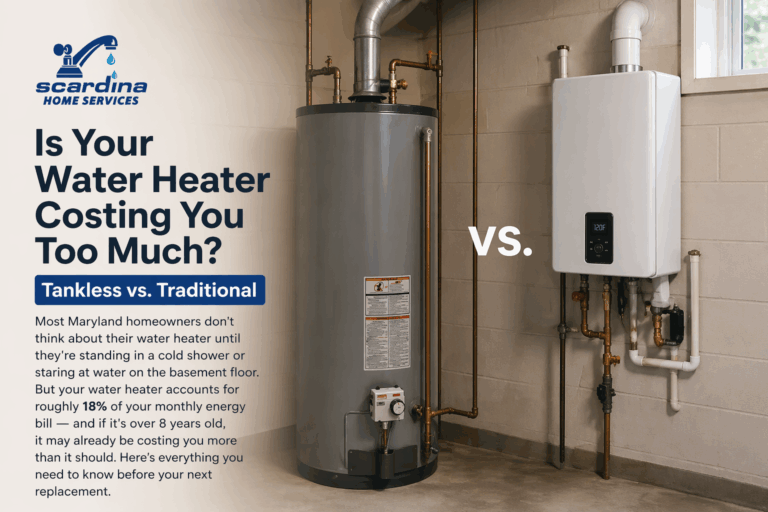
The vast majority of homes in central Maryland are equipped with storage tank water heaters. These are the cylindrical units — typically 40 to 50 gallons — that sit in your basement or utility closet and keep a full reservoir of water hot around the clock, whether you’re using it or not.
How They Work
A gas or electric heating element heats the water in the tank and maintains it at your set temperature (typically 120°F–140°F) continuously. When you turn on a hot water tap, hot water flows from the top of the tank and is replaced by cold water entering at the bottom, which then gets heated. When demand exceeds what’s in the tank — say, four people showering in a row — you run out and have to wait for the tank to reheat.
The Standby Loss Problem
The biggest efficiency drawback of a traditional tank is something called standby heat loss. Because the tank is constantly keeping 40–50 gallons of water hot, it’s consuming energy even at 2 a.m. when nobody in the house is awake. The water cools slightly, the burner or element fires up to bring it back to temperature, and the cycle repeats all day and night — regardless of your actual hot water use.
This is the core inefficiency that drives up your energy costs with a traditional tank unit, and it’s the main problem that tankless technology was designed to solve.
Pros of Traditional Tank Water Heaters
- Lower upfront cost — A standard tank unit and installation is typically less expensive than a tankless system
- Simpler installation — Replacement is often straightforward, especially when swapping like for like
- No flow rate limitations — A full tank delivers consistent volume to multiple outlets simultaneously
- Familiar technology — Well-understood by virtually every plumber and technician
Cons of Traditional Tank Water Heaters
- Shorter lifespan — 8 to 12 years on average, compared to 20+ for tankless
- Standby energy loss — Continuously heating water you’re not using drives up your monthly bill
- Hot water runs out — Once the tank is depleted, you wait
- Takes up significant space — Large footprint in basements and utility rooms
- Risk of tank failure — A cracked or corroded tank can leak or rupture, causing significant water damage
Tankless Water Heaters: The On-Demand Alternative
Tankless water heaters — also called on-demand or instantaneous water heaters — work on a completely different principle. There is no storage tank. Instead, when you turn on a hot water tap, cold water passes through a heat exchanger inside the unit, where a gas burner or electric element heats it instantly and delivers it on demand.
Because there’s no tank to keep hot around the clock, there’s no standby heat loss. The unit only fires when you actually need hot water.
The Energy Savings — By the Numbers
The efficiency advantage of tankless over traditional storage is well-documented by the U.S. Department of Energy:
- For households using 41 gallons or less of hot water per day, tankless water heaters can be 24% to 34% more energy efficient than conventional storage tank models.
- For households using around 86 gallons per day, the efficiency advantage is still 8% to 14%.
- According to ENERGY STAR, a certified gas tankless water heater saves a family of four approximately $95 per year on gas bills compared to a standard gas storage unit — or $1,800 over the unit’s lifetime.
- The Department of Energy estimates a gas-powered tankless unit lowers annual energy costs by around $100 per year compared to a tank model.
These numbers don’t include the compounding savings from not having to replace the unit as frequently (more on that below).
Lifespan: The Long Game
One of the most compelling financial arguments for tankless is longevity. According to the Department of Energy, most tankless water heaters have a life expectancy of more than 20 years — roughly double the lifespan of a traditional storage tank. They also have easily replaceable parts, which means many repairs that would end the life of a tank unit are simple fixes on a tankless system.
When you factor in that you may need to purchase and install two storage tank water heaters in the same period you’d own one tankless unit, the higher upfront cost looks quite different.
The Flow Rate Question
Tankless systems do have one limitation worth understanding: flow rate. Most residential tankless units deliver hot water at 2 to 5 gallons per minute. For the average household, this is more than sufficient — a shower typically uses 1.5 to 2.5 gallons per minute, and a kitchen faucet around 1 to 2 gallons per minute.
Where homeowners occasionally run into issues is when running multiple high-demand applications simultaneously — a shower, the dishwasher, and the washing machine all at the same time. In these situations, a single whole-home tankless unit may be stretched. A properly sized unit selected for your household’s specific peak demand eliminates this concern, which is why getting a professional assessment before installation matters.
Pros of Tankless Water Heaters
- 24%–34% more energy efficient for average households (U.S. Department of Energy)
- Endless hot water — No tank to deplete; hot water flows as long as you need it
- 20+ year lifespan — Roughly double that of a traditional storage tank
- Space savings — Wall-mounted units free up significant floor space in basements and utility rooms
- No risk of tank rupture — No tank means no risk of catastrophic flooding from a failed tank
- Replaceable parts — Many issues that would require full replacement of a tank unit are repairable on tankless systems
Cons of Tankless Water Heaters
- Higher upfront cost — Equipment and installation costs more than a traditional tank replacement
- Flow rate limitations — May struggle to serve multiple simultaneous high-demand uses without proper sizing
- Installation complexity — Gas tankless units may require upgraded venting and gas supply lines; electric units may require panel upgrades
- Cold-water sandwich — Brief initial burst of cold water before hot water reaches the fixture (common in all water heater types but occasionally more noticeable with tankless)
Tankless vs. Traditional: Side-by-Side Comparison
| Traditional Tank | Tankless (On-Demand) | |
|---|---|---|
| Average Lifespan | 8–12 years | 20+ years |
| Energy Efficiency | Baseline | 8%–34% more efficient |
| Hot Water Supply | Limited by tank size | Unlimited (flow-rate dependent) |
| Upfront Cost | Lower | Higher |
| Long-Term Cost | Higher (energy + replacement) | Lower |
| Space Required | Large footprint | Wall-mounted, compact |
| Risk of Water Damage | Tank rupture possible | No tank = no tank failure |
| Annual Energy Savings vs. Tank | — | ~$95–$100/year (gas) |
What About Maryland’s Water Quality?
Central Maryland — including Anne Arundel County and the surrounding region — is known for moderately hard water in many areas. This matters for both types of water heaters.
Hard water accelerates sediment and mineral buildup inside storage tanks, shortening their effective lifespan and reducing efficiency even faster than the averages above suggest. The rumbling and popping noises so many Maryland homeowners notice from their tank units are almost always a direct result of this mineral buildup.
Tankless water heaters are not immune to hard water effects — scale can accumulate on the heat exchanger over time — but they are easier to descale and maintain than a full storage tank. Regular annual maintenance, which Scardina Home Services provides, keeps both types of units operating efficiently and extends their service life.
If hard water is a concern at your home, Scardina also offers water treatment solutions that can protect your entire plumbing system, including your water heater, from premature mineral-related wear.
The Financing Question: What Does It Actually Cost?
Upfront cost is the most common reason Maryland homeowners hesitate on tankless. It’s a fair concern — tankless units and their installation do cost more than a direct tank replacement.
But the full financial picture is more nuanced:
Traditional tank replacement:
- Equipment and installation at roughly 8–12 year intervals
- Higher monthly energy bills due to standby losses
- Potential emergency replacement costs if the tank fails unexpectedly (which almost always happens at the least convenient time)
Tankless installation:
- Higher upfront cost
- ~$95–$100/year in energy savings
- 20+ year lifespan means one unit where you might have needed two
- Reduced risk of catastrophic water damage from tank failure
Financing is available. Scardina Home Services offers financing options to make the upfront cost of a tankless water heater more manageable — spreading payments in a way that, when factored against energy savings, can make the switch cash-flow neutral from day one. There are also potential rebates and incentives available depending on the unit and fuel type. Ask us about current available programs when you call.
So Which One Is Right for Your Maryland Home?
There’s no universal answer, but here’s a practical framework:
A tankless water heater is likely the right move if:
- Your current tank is 8+ years old and you’re planning proactively
- Your household runs out of hot water regularly
- You want to reduce your monthly energy costs over the long term
- You value the peace of mind of eliminating tank rupture risk
- You’re doing a renovation and have an opportunity to upgrade infrastructure
A traditional tank replacement may make more sense if:
- Your current unit is relatively new and you’re dealing with a specific, repairable problem
- Upfront cost is a significant constraint and financing isn’t an option
- Your home’s current gas or electrical infrastructure makes tankless conversion complex
The honest answer is that for most Maryland homeowners with an aging water heater, the math favors going tankless — especially when you account for lifespan, energy savings, and the elimination of emergency replacement risk. But the right answer for your specific home depends on your household size, water usage patterns, existing infrastructure, and budget.
That’s exactly the kind of assessment the team at Scardina Home Services does every day.
Don’t Wait for the Cold Shower
The worst time to make a water heater decision is at 7 a.m. on a Tuesday when you have 20 minutes until you need to leave for work and there’s no hot water. Or worse — when there’s water spreading across your basement floor.
Proactive replacement on your timeline means you can compare options carefully, take advantage of financing, and have the right unit installed correctly — not whatever’s available for emergency same-day delivery.
If your water heater is 8 years or older, or if you’re noticing any of the warning signs described in this post, now is the right time to have it looked at.
Ready to Stop Overpaying for Hot Water?
Scardina Home Services has been serving central Maryland homeowners — including Glen Burnie, Severn, Millersville, Odenton, Crofton, Crownsville, Pasadena, Severna Park, Annapolis, and surrounding areas — with honest, expert plumbing and HVAC service.
Our team can assess your current water heater, walk you through the tankless vs. traditional comparison for your specific home, and provide a transparent estimate with no pressure.
📞 Call us at 410.782.0937 🌐 Request a free estimate online at scardinahome.com/estimate-service
Financing available. Ask about current rebates and incentives.
Sources
- U.S. Department of Energy — Tankless or Demand-Type Water Heaters
- U.S. Department of Energy — Water Heating
- ENERGY STAR — When Should You Replace Your Water Heater
- ENERGY STAR — Save More with ENERGY STAR Gas Tankless Water Heaters
- Rheem — Water Heater Lifespan: When to Repair vs. Replace
- A.O. Smith — When to Repair or Replace Your Water Heater
Frequently Asked Questions
How do I know if my water heater needs to be replaced or just repaired?
A good rule of thumb is the 50% rule: if the cost of the repair exceeds 50% of the price of a new unit, replacement is almost always the smarter investment. Age is the other major factor — if your unit is 10 years or older and experiencing recurring issues, repairs are typically just delaying the inevitable. A tank that is actively leaking from the base, showing rust-colored water, or making persistent rumbling noises after a flush is usually beyond the point where repair makes financial sense. When in doubt, a quick assessment from a licensed plumber can give you a clear answer without any obligation.
How much does a tankless water heater cost to install in Maryland?
The total cost varies based on the type of unit (gas vs. electric), the size needed for your household, and the complexity of the installation — including whether your home needs upgraded gas lines, venting, or electrical panel work. Gas tankless units generally run higher in installation cost due to venting requirements, but they also tend to deliver greater energy savings. The best way to get an accurate number for your specific home is to request a free estimate. Scardina Home Services provides transparent, no-pressure quotes and financing options that can make the upfront cost much more manageable.
Will a tankless water heater work for a large family?
Yes — but proper sizing is critical. A tankless water heater delivers hot water on demand rather than drawing from a stored supply, so the key variable is flow rate: how many gallons per minute the unit can heat simultaneously. A correctly sized unit handles a large household’s peak demand without issue. Where problems arise is when a unit is undersized for the home’s actual simultaneous hot water needs. That’s why a professional assessment of your household size, usage patterns, and peak demand is an essential first step before installation — not an afterthought.
How long does it take to install a tankless water heater?
A straightforward replacement — where the infrastructure is already compatible — typically takes a few hours. More involved installations, such as those requiring new gas line work, upgraded venting, or electrical panel changes, will take longer. In most cases, your home will have hot water restored the same day. Scardina Home Services schedules installations at times that work for you and walks you through exactly what to expect before the work begins.
Do tankless water heaters require maintenance?
Yes, and this is something Maryland homeowners in particular should take seriously. Annual maintenance — which typically involves flushing the heat exchanger to remove mineral scale — keeps the unit operating at peak efficiency and protects the warranty. Given central Maryland’s moderately hard water, skipping this maintenance can shorten the lifespan of a tankless unit and reduce its energy efficiency over time. The good news is that maintenance on a tankless unit is simpler and less involved than draining and flushing a storage tank, and Scardina offers scheduled maintenance plans to keep yours running at its best.
Can I get rebates or tax incentives on a new water heater in Maryland?
Potentially, yes. Depending on the unit type, energy efficiency rating, and current available programs, there may be manufacturer rebates, utility rebates, or federal tax incentives available to offset the cost of a new water heater — particularly for high-efficiency tankless or heat pump models. These programs change periodically, so the most reliable approach is to ask directly when you call. Scardina Home Services stays current on available rebates and incentives and will factor them into your estimate.
What happens if I ignore the warning signs and my water heater fails suddenly?
A sudden water heater failure typically means one of two outcomes: no hot water until an emergency replacement can be scheduled, or — in the case of a tank rupture — significant water damage to your home. Emergency service calls are almost always more expensive than planned replacements, and making a major purchase under time pressure limits your ability to compare options and choose the right unit for your home. If your water heater is showing warning signs, acting proactively is almost always the less expensive and less stressful path.
How do I find out how old my water heater is?
The age of your water heater is encoded in its serial number, which is printed on the rating plate — usually a sticker located on the upper portion of the unit. The format varies by manufacturer, but in most cases the first four characters of the serial number indicate the month and year of manufacture. If you’re unsure how to read it, take a photo of the full rating plate and share it with Scardina when you call — we can tell you exactly how old the unit is and what that means for its remaining service life.